
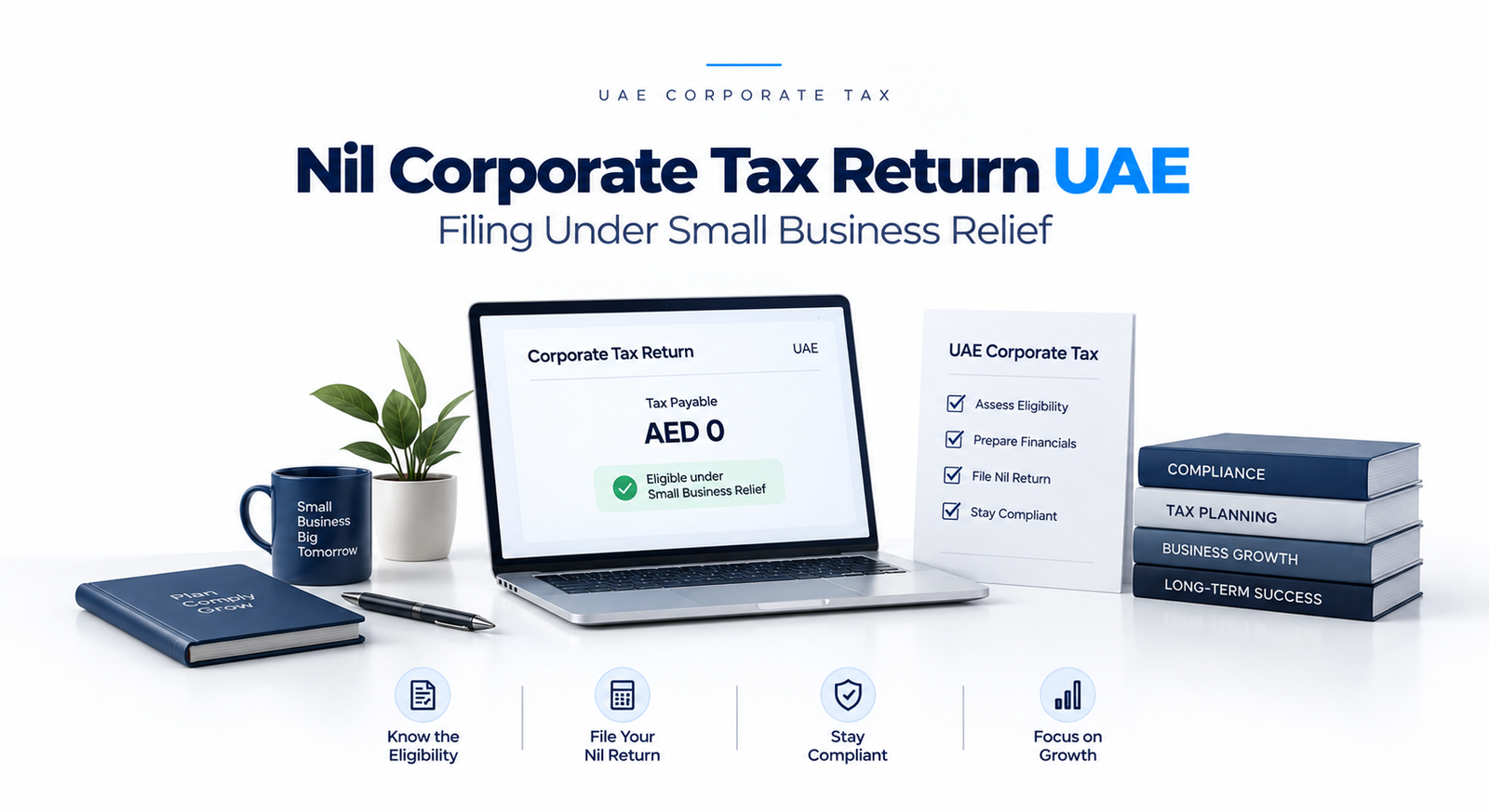
An active UAE business with Revenue of AED 3,000,000 or less in the current and every earlier tax period can elect Small Business Relief in its Corporate Tax return and pay AED 0, even if it made a profit. You must still be registered, declare your Revenue, tick the election on EmaraTax every year and file by the deadline, which is 30 September 2026 for December 2025 year ends.
- Your company or licensed business is resident in the UAE and trades with real customers
- Revenue has never passed AED 3,000,000 in any Corporate Tax period
- You are not a Qualifying Free Zone Person and not part of a very large multinational group
- Your first or next Corporate Tax return is due, for example on 30 September 2026
Not sure where you stand? Get a free 15-minute review or ask us on WhatsApp.
Can your business file a Corporate Tax return with no tax due under Small Business Relief?
Yes, if you are a UAE resident business whose Revenue has stayed at or below AED 3,000,000 in this tax period and every earlier one, and you are not excluded. The relief is elective: nothing happens unless you choose it inside the return.
This guide is for businesses that are trading. If your company had no activity at all, our guide to the nil return for dormant and zero revenue companies covers that case, including what to submit when there is nothing to report.
| Your situation | Can you elect Small Business Relief? | What to watch |
|---|---|---|
| Mainland LLC, Revenue AED 2.2M, never above AED 3M | Yes | Declare gross Revenue, not profit |
| Free zone company that is not a Qualifying Free Zone Person | Yes | Same AED 3M test as the mainland |
| Qualifying Free Zone Person claiming 0% on qualifying income | No | Audited statements are required instead |
| Revenue was AED 4.3M last year, AED 1.9M this year | No | Once over AED 3M, the relief is closed for later periods |
| Individual with a licensed business and turnover above AED 1M | Yes, if turnover is AED 3M or less | Natural persons only enter Corporate Tax above AED 1M |
| Constituent company of a group with AED 3.15bn consolidated revenue | No | Multinational group members are excluded |
| Foreign company operating through a Dubai office | Generally no | Non-residents are outside the relief |
Two points trip owners up. First, every UAE company must still register for Corporate Tax and file, whatever its Revenue. Second, VAT runs on separate thresholds (AED 375,000 mandatory, AED 187,500 voluntary), so electing Small Business Relief does not change your VAT position.
What does a nil return under Small Business Relief actually mean?
It means the FTA treats you as having no Taxable Income for that period, so the tax line is AED 0. It does not mean you had no sales: you still report your Revenue, and that figure is what proves you qualify.
Small Business Relief is not the AED 375,000 0% band
Without the relief, Corporate Tax is 0% on Taxable Income up to AED 375,000 and 9% on the part above it, and you must calculate Taxable Income in full. With the relief, you skip that calculation and pay nothing, however profitable the year was. The value of electing therefore grows with your profit, as the table shows.
| Profit (Taxable Income) | Tax without the relief | Tax with the relief |
|---|---|---|
| AED 200,000 | AED 0 (inside the 0% band) | AED 0 |
| AED 520,000 | 9% x 145,000 = AED 13,050 | AED 0 |
| AED 1,200,000 | 9% x 825,000 = AED 74,250 | AED 0 |
Why a profitable trading business benefits most
A consultancy with AED 2.8M of fees and thin costs, or a contractor with a strong year, can save tens of thousands of dirhams. A business earning under AED 375,000 pays AED 0 either way, so for it the relief is mainly a simpler return, and it should read our guide on when not to elect Small Business Relief before ticking the box.
How do you calculate Revenue for the AED 3 million test?
Revenue is the gross income in your financial statements for the period, before any costs. The FTA is explicit that it includes every kind of income, not only sales, and the test applies to this period and all previous Corporate Tax periods.
Cash basis is allowed up to AED 3 million
Under Ministerial Decision No. 114 of 2023, a business with Revenue of AED 3,000,000 or less may prepare its financial statements on the cash basis instead of the accrual basis. The FTA can challenge the result if it is unreasonable, for example if invoices are held back to keep Revenue under the limit. Our guide to accounting standards for Corporate Tax explains both methods.
The all previous periods trap
If Revenue went above AED 3,000,000 in any earlier period, you cannot elect again, even if this year is smaller. The FTA’s own example: AED 4.3M in 2025 and AED 1.9M in 2026 means no relief in 2026. Check every return you have filed before assuming you qualify.
| Item | Include in Revenue? | Why |
|---|---|---|
| Sales of goods and service fees | Yes | Core income |
| Dividends received | Yes | FTA example: AED 1.5M sales plus AED 1.0M dividends gives AED 2.5M Revenue |
| Proceeds from selling a company car or equipment | Yes | The guide names asset sales as Revenue |
| Goods received in a barter | Yes, at market value | Non-cash receipts count |
| VAT charged to customers | No | The VAT belongs to the FTA |
| Owner capital injected | No | Not income |
What do you still have to do after electing Small Business Relief?
You still file, keep records and price related party dealings at market value; what you skip is the tax calculation and transfer pricing paperwork. The FTA sets out the trade-offs in a comparison that is summarised below.
Records for 7 years
Keep the documents that prove your Revenue for 7 years after the period ends. For a period ending 31 December 2026, that means keeping them until 31 December 2033. If your books have gaps, fix them first with catch-up bookkeeping, because a nil return with no records behind it is exposed on audit.
Audited statements are rarely needed
Under Ministerial Decision No. 84 of 2025, audited financial statements are required for Revenue above AED 50,000,000 and for every Qualifying Free Zone Person. A typical Small Business Relief filer is neither, although your licensing authority may have its own rule, which our free zone audit requirements guide covers zone by zone.
Do not split the business to stay under AED 3M
Running food and drinks sales through separate companies, giving each branch of a café chain its own licence, or rotating short-lived entities are all examples of artificial separation in the FTA guide. The FTA can deny the relief, recover the tax that would have been due and impose a penalty.
| Obligation or relief | If you elect | If you do not elect |
|---|---|---|
| Register and file a return | Required | Required |
| Calculate Taxable Income | Not required | Required |
| Record and carry forward a tax loss for this period | Not possible | Possible |
| Deduct or carry forward net interest for this period | Not possible | Possible, within the interest rules |
| Qualifying Group and Business Restructuring reliefs | Not available | Available |
| Transfer pricing documentation | Not required | Required where applicable |
| Arm’s length pricing with related parties | Required | Required |
How to file your Corporate Tax return with the Small Business Relief election on EmaraTax
The election sits in section 5.3 of the Corporate Tax return, and it only appears if the details you entered earlier make you eligible.
Confirm eligibility against your filing history
Check you are resident, not a Qualifying Free Zone Person, not in a group with AED 3.15bn consolidated revenue, and that no earlier return shows Revenue above AED 3,000,000.
Close the books for the period
Reconcile sales to bank statements, POS reports and marketplace payouts, and prepare financial statements on the accrual or cash basis.
Build the Revenue working
Add sales, fees, dividends, interest and any asset sale proceeds, then remove VAT collected. Keep this working with your records.
Open the return and complete Taxable Person details
Log in to EmaraTax, open the Corporate Tax return for the period and enter your Revenue in the Taxable Person information section.
Answer the election question
In section 5.3, field 5.3.1 shows your Revenue pre-populated. At field 5.3.2, ‘Would the Taxable Person like to make an election for Small Business Relief?’, select Yes.
Review the declarations and submit
Check the TRN, period dates and Revenue, then submit before 30 September 2026 for a December 2025 year end. Save the acknowledgement.
Diary next year's election
The election does not roll forward. Set a reminder to review eligibility and tick it again in your next return.
Documents to keep behind a Small Business Relief return
You do not upload most of these, but the FTA can ask for them for 7 years, so keep them in one place.
- Corporate Tax registration certificate and TRN
- Financial statements for the period (cash or accrual basis)
- Revenue working showing every income line and the VAT removed
- Sales invoices, POS and marketplace settlement reports
- Bank statements for all business accounts
- Sale documents for any vehicles, equipment or business lines sold
- Agreements and invoices for dealings with owners, relatives and group companies, showing market prices
- Copies of earlier returns proving Revenue never exceeded AED 3,000,000
- EmaraTax submission acknowledgement
When is the Small Business Relief return due?
The return is due 9 months after your tax period ends, and the relief itself is available for periods ending on or before 31 December 2029 after Ministerial Decision No. 131 of 2026, announced on 7 August 2026, extended it.
| Your year end | Return and any payment due | Notes |
|---|---|---|
| 31 December 2025 | 30 September 2026 | The deadline most owners face now |
| 30 June 2026 | 31 March 2027 | 9 months after period end |
| 31 December 2026 | 30 September 2027 | Relief still available |
| 31 December 2029 | 30 September 2030 | Last period end covered by the extension |
| Records for a 31 December 2026 period | Keep until 31 December 2033 | 7 years |
What penalties apply if a Small Business Relief return is late or wrong?
A late return is penalised even when the tax due is AED 0, because the penalty is for not filing, not for unpaid tax. These are the 2026 amounts under Cabinet Decision No. 75 of 2023 as amended.
| Violation | Penalty |
|---|---|
| Return filed after the deadline | AED 500 for each month or part month for the first 12 months, then AED 1,000 a month |
| Late Corporate Tax registration | AED 10,000, waived if the first return is filed within 7 months of the end of the first tax period |
| Records not kept | AED 10,000, or AED 20,000 for a repeat within 24 months |
| Tax unpaid after the relief is denied | 14% a year, calculated monthly |
| Artificial separation to claim the relief | Relief denied, tax recovered, and a penalty may be imposed |
Here is how it stacks. A business due to file by 30 September 2026 that submits on 5 February 2027 is charged AED 500 on 1 October, 1 November, 1 December, 1 January and 1 February: AED 2,500 for a return with no tax in it. See our full Corporate Tax penalties guide for the rest of the schedule.
Is a late filing penalty already building?
If your return with no tax due is past 30 September 2026, each month adds a penalty; we check your eligibility and file fast.
7 mistakes business owners make when filing under Small Business Relief
Most problems come from the Revenue figure or from assuming the relief is automatic.
- Entering profit instead of Revenue. The test is gross income, so a low profit figure can hide a business that is really over AED 3M.
- Leaving out one-off income. Selling a van or receiving dividends counts, and it can push Revenue over the limit for good.
- Including VAT in Revenue. This overstates income and can make an eligible business think it is ineligible.
- Assuming last year’s election carries over. It does not; an unticked box means a full return and possibly tax.
- Electing in a loss year without thinking. The loss is gone for good, which costs 9% later if profits arrive.
- Not registering because the relief will apply anyway. Registration is required first and late registration costs AED 10,000.
- Relying on old guidance that the relief ends in 2026. It was extended to periods ending 31 December 2029, so do not rush into restructuring.
How to keep your Small Business Relief filing penalty-free
A light monthly routine makes the annual return a 30 minute job.
- Monthly: reconcile bank, POS and platform payouts to your sales ledger
- Monthly: tag one-off income such as asset sales so it is not missed
- Quarterly: compare year-to-date Revenue with AED 3,000,000 and forecast the year end
- Quarterly: file VAT 201 returns on time if you are VAT registered
- Annually: close the books and prepare financial statements within 3 months of year end
- Annually: decide elect or not elect, using a full Taxable Income estimate
- Annually: submit the return well before the 9 month deadline
- Always: keep related party agreements and records for 7 years
Missed the deadline or received an FTA notice about your return?
File the return now: the late filing penalty is charged on the same date each month, so every month you wait adds AED 500 in the first year. Our missed Corporate Tax deadline guide sets out a 7 day plan.
If you filed but made an error, such as the wrong Revenue or a missed election, correct it through the FTA’s voluntary disclosure process rather than waiting for an audit. If the FTA issues a penalty you believe is wrong, you can request reconsideration within 40 business days of the decision, and if that fails, take it to the Tax Disputes Resolution Committee. Our guide to requesting FTA reconsideration walks through the wording.
Remember the late registration waiver: if your first return is filed within 7 months of the end of your first tax period, the AED 10,000 registration penalty can be waived.
FTA notice about your return or registration?
Send us the notice and we will tell you what to file first and whether reconsideration is worth requesting.
Worked example: a fit-out company with AED 520,000 profit pays AED 0
An illustrative Dubai interior fit-out LLC with a calendar year closes 2025 with the figures below. Revenue in 2024 was AED 1,900,000, so the all previous periods test is met.
| Line | Amount |
|---|---|
| Fit-out income (excluding VAT) | AED 2,150,000 |
| Sale of a used pickup | AED 45,000 |
| Bank interest | AED 5,000 |
| Revenue for the test | AED 2,200,000 |
| Expenses | AED 1,680,000 |
| Profit | AED 520,000 |
| Tax without the relief: 9% x (520,000 minus 375,000) | AED 13,050 |
| Tax with the relief elected | AED 0 |
| Penalty if filed on 20 November 2026 instead of 30 September 2026 | AED 1,000 (2 monthly charges) |
The VAT of AED 107,500 charged on the fit-out income is excluded from Revenue. The saving from electing is AED 13,050, but it is only safe if the business keeps the Revenue working and invoices for 7 years. You can test your own numbers with the Corporate Tax estimator.
Should you file the Small Business Relief return yourself, use a freelancer or hire a firm?
A simple, single activity business with clean books can file itself; the risk rises with one-off income, related parties or a loss year. The table compares the options in general terms.
| Option | Cost | Time for you | Risk | Suits |
|---|---|---|---|---|
| Do it yourself on EmaraTax | No fee | High the first year | Revenue errors, missed election, missed trade-offs | One activity, clean books, no related parties |
| Freelance bookkeeper | Typical market range: low, varies widely | Medium | Depends on the person; limited review | Stable businesses with simple ledgers |
| Accounting firm | Fixed quote | Low | Lowest, with a second review of eligibility and trade-offs | Profitable years, asset sales, loss years, growing Revenue |
Paci gives you a fixed quote within 24 hours after a free 15-minute review with a qualified accountant, with no hourly billing, and bookkeeping starts from AED 599 a month. Compare typical costs in our Corporate Tax filing cost guide, or go straight to our Corporate Tax filing service.
What business owners ask us about filing under Small Business Relief
Our small free zone company has Revenue in the mid AED 200,000s. Can we file ourselves, or do we need someone?
You can file on EmaraTax yourself. If the company is resident and not a Qualifying Free Zone Person, it can elect Small Business Relief and pay AED 0. The risks are in the detail: Revenue must include all income, the election must be ticked each year, and the return is due 9 months after year end.
I run a single-owner free zone company billing one overseas client, with turnover around AED 1.2 million. Can I use a bookkeeping app and claim the relief myself?
Yes, provided Revenue stays at or below AED 3,000,000 in every period and you are not a Qualifying Free Zone Person. Keep books that support Revenue for 7 years, and make sure what you pay yourself is at market value, because the arm’s length rule still applies under the relief.
Our free zone company opened in October 2024 and the first return is due 30 September 2026. Is it risky to file close to the deadline?
There is no penalty for filing near the deadline, only after it, when AED 500 is charged each month. Filing a few weeks early leaves time to fix EmaraTax errors. If the company is a free zone company but not a Qualifying Free Zone Person, it can elect the relief.
We registered late, got the AED 10,000 penalty, then filed our first return within a few months of year end. Why is the penalty still showing?
The FTA waives the late registration penalty when the first return is filed within 7 months of the end of the first tax period, so a timely first return should qualify. Raise it with the FTA through EmaraTax, and if a decision goes against you, request reconsideration within 40 business days.
I keep hearing Small Business Relief only runs to 2026. Should I plan to pay 9% from 2027?
No. Ministerial Decision No. 131 of 2026, announced on 7 August 2026, extended the relief to tax periods ending on or before 31 December 2029, with the same AED 3,000,000 limit. You still need to pass the Revenue test every year.
I do marketing work for overseas clients on a licence in my own name and earn about AED 45,000 a month. What do I file?
If the licence is in your personal name, you only enter Corporate Tax once business turnover passes AED 1,000,000 in a calendar year, and about AED 540,000 is below that. If the business is a company, it files every year and can elect the relief. Our freelancer Corporate Tax guide explains the AED 1 million rule.
Frequently asked questions
Is Small Business Relief applied automatically?+
No. You must be registered for Corporate Tax and select Yes to the Small Business Relief question in each return. If you do not make the election, the FTA treats the return as a full return and you must calculate Taxable Income.
Is Small Business Relief the same as the 0% Corporate Tax band?+
No. The 0% band taxes the first AED 375,000 of Taxable Income at 0% and the rest at 9%, and anyone can use it. Small Business Relief is an election for Revenue up to AED 3,000,000 that treats all your income as nil, so a very profitable small business pays AED 0.
Do I need audited financial statements to claim Small Business Relief?+
Usually not. Under Ministerial Decision No. 84 of 2025, audited statements are required for Revenue above AED 50,000,000 and for Qualifying Free Zone Persons, and neither can realistically claim the relief. You still need financial statements, and your licensing authority may ask for audited accounts at renewal.
Can a free zone company claim Small Business Relief?+
Yes, if it is not a Qualifying Free Zone Person. A free zone company paying the standard rates can elect when its Revenue is AED 3,000,000 or less in every period. A Qualifying Free Zone Person cannot. See our Qualifying Free Zone Person guide.
What happens if my Revenue goes over AED 3 million?+
You cannot elect for that period, and you cannot elect in any later period even if Revenue drops back. You file a full return, where the AED 375,000 0% band still applies. Plan large asset sales carefully, because they count as Revenue.
Until when can UAE businesses use Small Business Relief?+
For tax periods ending on or before 31 December 2029. The relief was extended by Ministerial Decision No. 131 of 2026, announced on 7 August 2026, and the AED 3,000,000 Revenue limit is unchanged.
Does electing Small Business Relief change my VAT obligations?+
No. VAT registration, VAT 201 returns and invoicing continue as normal on their own thresholds of AED 375,000 mandatory and AED 187,500 voluntary. The only link is that VAT you charge is excluded when you calculate Revenue for the relief.
Get your Small Business Relief return checked for free
In a free 15-minute review a qualified accountant checks your Revenue working, eligibility history and whether electing is the right call this year. You get a fixed quote within 24 hours to prepare and file the return.
- A free 15-minute review with a qualified accountant
- A fixed quote within 24 hours, no hourly billing
- We reply on WhatsApp or email, whichever you prefer
Continue on WhatsApp now →
- FTA: Corporate Tax Guide on Small Business Relief (CTGSBR1)
- FTA: Corporate Tax Guide on Tax Returns (CTGTXR1)
- MoF: Cabinet Decision No. 75 of 2023 and its amendments
- FTA: Waiver of Penalties
- MoF: Decision on Small Business Relief for Corporate Tax purposes
Checked against these sources on 15 September 2026. This guide is general information for UAE businesses, not advice on your specific facts.