
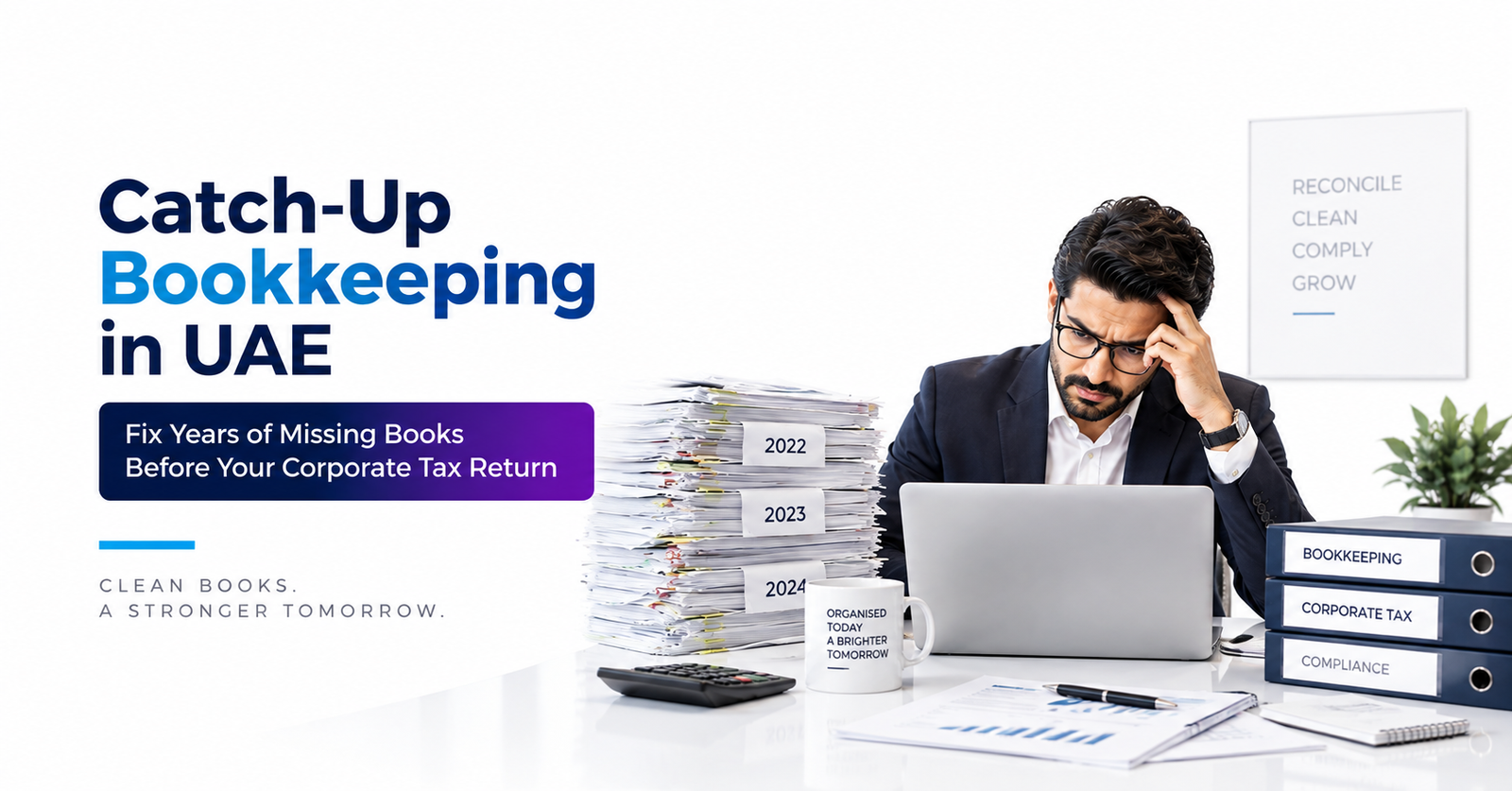
Catch-up bookkeeping rebuilds missing accounts from bank statements, sales invoices, supplier bills and marketplace or POS reports so overdue Corporate Tax and VAT returns can be filed correctly. Start with the oldest open period, because each year’s closing balances open the next. In the UAE, records not kept can cost AED 10,000, and a late Corporate Tax return adds AED 500 a month.
- Your company has traded for a year or more without a proper ledger or accounting software
- Your Corporate Tax return is due and the only numbers you have are bank balances
- You registered for Corporate Tax late and now have overdue returns to file
- Your VAT returns were filed from estimates and you suspect they are wrong
- A bookkeeper left and nobody has updated the accounts since
Not sure where you stand? Get a free 15-minute review or ask us on WhatsApp.
Do you need catch-up bookkeeping before filing your returns?
You need catch-up bookkeeping if any Corporate Tax or VAT return you owe cannot be traced line by line to invoices and bank transactions. Every UAE company must register and file for Corporate Tax whatever its revenue, so almost every company with a gap in its books is affected.
Use the table to see how urgent your situation is. The thresholds decide which returns your rebuilt books must support.
| Your situation | Returns the books must support | Urgency |
|---|---|---|
| Any UAE company, mainland or free zone | Corporate Tax return every year, even with zero revenue | High if a year end was 31 December 2025 (due 30 September 2026) |
| Taxable supplies and imports over AED 375,000 in 12 months | Mandatory VAT registration and VAT 201 returns by the 28th after each period | High: each late VAT return costs AED 1,000 |
| Taxable supplies between AED 187,500 and AED 375,000 | VAT only if you registered voluntarily | Medium |
| Revenue up to AED 3M electing Small Business Relief | Corporate Tax return still filed, full records still kept | Medium to high |
| Free zone company claiming 0% as a Qualifying Free Zone Person | Audited financial statements plus the return | Highest: an auditor needs complete books first |
| Individual with business turnover over AED 1M in a calendar year | Corporate Tax registration by 31 March of the next year, return by 30 September | High once over the threshold |
Small Business Relief does not reduce the record-keeping duty. It is an election for resident companies with revenue up to AED 3M, for tax periods ending on or before 31 December 2029, and you still need books that prove the revenue figure. Our UAE bookkeeping FAQ covers the basic record rules.
How to rebuild books from bank statements, invoices and platform reports
Rebuild from the bank outward: every bank line becomes a transaction, and every transaction is then matched to a document that explains it. The bank statement is the one record the FTA and your bank both hold, so it is the backbone of any catch-up job.
Step one: import and categorise every bank line
Load each statement into accounting software or a structured spreadsheet and give every line a category using a proper chart of accounts. Do not skip small items: bank charges, licence fees and transfers between your own accounts all have to land somewhere. Our UAE chart of accounts guide gives a starting structure.
Step two: gross up net deposits
Card acquirers, marketplaces and delivery apps pay you after deducting fees and refunds. Filing those net deposits as revenue understates sales and overstates margin. Pull the platform reports, record the gross sale, then book commissions and fees as expenses so the net figure matches the bank.
Step three: separate the owner from the company
Owners who ran the company alone usually mixed personal and business money. Transfers to yourself are drawings, salary or loan repayments, not expenses, and costs you paid personally are amounts the company owes you. Record them on a shareholder account, explained in our guide to the director loan account. Salary paid to yourself is a connected person payment that must be at arm’s length and disclosed with the Corporate Tax return.
Step four: reconcile to the penny
Each month is finished only when the ledger bank balance equals the statement balance. A monthly bank reconciliation is what turns a categorised list into books an FTA auditor will accept.
| Source | What it proves | Gap it fills |
|---|---|---|
| Bank statements (every account, every month) | Money in and out, dates and counterparties | The complete list of transactions to explain |
| Sales invoices and quotations | What you sold, to whom, and the VAT charged | Revenue that arrived as one lump payment for several jobs |
| Supplier bills and receipts | What you bought and the input VAT paid | Deductible costs and reclaimable VAT |
| Card terminal settlement reports | Gross card sales before bank fees | The difference between sales and net deposits |
| Marketplace and delivery app statements | Gross orders, commissions, refunds and fees | Revenue that platforms paid out net |
| Payroll and WPS files | Salaries, allowances and end of service accruals | Staff costs paid in bulk |
| Customs declarations | Imported goods and import VAT | Stock purchases and VAT recoverable on imports |
Setting opening balances for your first Corporate Tax period
Your first Corporate Tax period needs an opening balance sheet: what the company owned and owed on the first day of that period. Without it, the first return reports profit or loss on the wrong base, and every later year inherits the error.
| Opening balance | How to establish it | Common problem |
|---|---|---|
| Cash at bank | Bank statement balance on the first day of the period | Forgotten second account or old savings account |
| Customer balances owed to you | Unpaid invoices at that date, confirmed against later receipts | Invoices that were never going to be paid |
| Supplier balances you owed | Unpaid bills at that date, supplier statements | Suppliers paid in cash with no receipt |
| Stock | Count or best reconstruction at cost | No count was ever taken |
| Fixed assets | Purchase invoices less depreciation to date | Assets bought personally and used by the company |
| Owner loan or current account | Net of all money the owner put in and took out | Years of mixed transfers |
| Share capital | Memorandum of association | Capital never actually paid in |
Fixed assets deserve care, because the cost you record now drives depreciation for years. The rules are covered in our guide to fixed assets accounting in the UAE.
What to do when records are missing or past VAT returns were wrong
When a document is missing, rebuild the evidence from a second source rather than guessing: supplier statements, email trails, contracts, platform downloads and bank narratives can usually support a transaction. Where nothing can be found, treat the item cautiously and document why.
Ways to recover lost documents
- Ask each regular supplier for a statement of account covering the missing years
- Download invoice history from marketplace, delivery app and software subscription portals
- Search your email for PDF invoices, quotations and purchase orders
- Request duplicate tax invoices from suppliers where you want to reclaim input VAT
- Use signed contracts and bank narratives to support payments with no invoice
- Recover customs declarations for imports through your clearing agent
Costs you cannot support
An expense with no document and no second source is weak evidence in an FTA review. Record it with a note, but think twice before deducting it for Corporate Tax, and do not claim input VAT without a valid tax invoice. It is better to lose a small deduction than to carry an unsupported figure into a return.
When the rebuilt books show your old VAT returns were wrong
Catch-up work often reveals under-declared sales or over-claimed input VAT in returns already filed. Correct those errors through a voluntary disclosure before the FTA contacts you. Under Cabinet Decision 129/2025 the penalty is 1% a month on the tax difference if you disclose before an audit notice, and 15% plus 1% a month after one, which is why timing matters. Our guide to voluntary VAT disclosure explains the process.
The catch-up bookkeeping process, step by step
A catch-up job runs oldest period first and ends with filed returns, not just tidy spreadsheets. These are the steps in the order that avoids redoing work.
List every open obligation
Log in to EmaraTax and note each Corporate Tax period and VAT period, with due dates and whether a return was filed. This sets the order of work.
Collect bank statements for every account
Download statements from the date of incorporation or the last reliable balance to today, including closed accounts and payment gateway wallets.
Gather sales, purchase and platform documents
Pull invoices, supplier bills, card settlement reports and marketplace statements into one folder per year.
Set the opening balance sheet
Establish cash, receivables, payables, stock, assets and the owner account at the start of the first open period.
Post and reconcile month by month
Categorise every bank line, gross up net deposits and reconcile each month to the statement before moving to the next.
Close each year and produce accounts
Post year-end adjustments such as depreciation and accruals, then produce an income statement and balance sheet for the year.
Compare against past VAT returns
Rebuild each quarter’s output and input VAT and compare it with what was filed. Prepare voluntary disclosures for any differences.
File overdue returns and set up a monthly routine
File the oldest overdue Corporate Tax return first, then the rest in order, and move the company onto monthly bookkeeping so the gap never reopens.
What to send your accountant for a catch-up job
Send everything you have, even if it looks incomplete; an accountant can work with gaps but not with guesses. For a first estimate, three recent bank statements are usually enough to judge volume and complexity.
- Trade licence, memorandum of association and any amendments
- Corporate Tax and VAT registration certificates
- Bank statements for every account from the first open period to today
- Sales invoices, or an export from your invoicing or POS system
- Supplier bills, receipts and supplier statements
- Marketplace, delivery app and card terminal settlement reports
- Payroll registers, WPS files and employment contracts
- Lease, loan and major supplier contracts
- Customs declarations for imports
- Copies of VAT returns and any FTA notices already received
How long catch-up bookkeeping takes and the dates to work back from
Work back from your nearest filing date: for a 31 December 2025 year end, the Corporate Tax return is due 30 September 2026, so the books must be finished before then. How long the rebuild takes depends mainly on the number of transactions and how many documents are missing.
When the catch-up is finished, Corporate Tax return filing is the next step, and it goes much faster on reconciled books.
| Date or driver | What it means for your catch-up job |
|---|---|
| 30 September 2026 | Corporate Tax return and payment due for years ending 31 December 2025 |
| 28th of the month after each VAT period | VAT 201 return and payment due, so rebuilt quarters should be checked before the next return |
| 9 months after any other year end | Corporate Tax deadline for non-December year ends |
| 40 business days from an FTA decision | Window to request reconsideration of a penalty |
| A few transactions a month | Usually the fastest rebuild, often days per year of books |
| Hundreds of transactions and platform sales | Longer, because each settlement must be grossed up and matched |
| Missing supplier documents | Adds time waiting for statements and duplicate invoices |
Penalties for missing books and the returns they delay
Missing books are penalised twice: once for the records themselves and again for every return they make late or wrong. The VAT figures come from Cabinet Decision 129/2025 and the Corporate Tax figures from Cabinet Decision 75/2023 as amended.
| Violation | Penalty | How it connects to missing books |
|---|---|---|
| Records not kept (VAT) | AED 10,000 for a first violation, higher for a repeat | No ledger or invoices behind VAT returns |
| Records not kept (Corporate Tax) | AED 10,000, or AED 20,000 for a repeat within 24 months | Return filed from bank balances |
| Records not provided in Arabic on request | AED 5,000 | FTA asks for translated documents during a review |
| Late Corporate Tax return | AED 500 a month for 12 months, then AED 1,000 a month | Books not ready by the deadline |
| Late VAT return | AED 1,000 first, AED 2,000 repeat within 24 months, per return | Quarter skipped while the books were behind |
| Incorrect VAT return | AED 500 first, AED 2,000 repeat | Return filed from estimates |
| Incorrect Corporate Tax return | From AED 500, plus 1% a month on any tax difference | Profit calculated without cost of sales or accruals |
| Late payment of tax | 14% a year, calculated monthly | Tax discovered during the rebuild and paid late |
Here is how it stacks. A company that files its Corporate Tax return 8 months late pays AED 4,000. If the FTA then asks for records and the books do not exist, add AED 10,000. If two VAT quarters were also skipped, add AED 1,000 and AED 2,000. That is AED 17,000 before any tax difference, and all of it traces back to books that were never kept.
Behind on the books and worried about penalties?
Tell us which years are missing and a qualified accountant will estimate your late return and records exposure in a free 15-minute call.
6 mistakes that turn a bookkeeping backlog into penalties
The costliest catch-up mistakes are shortcuts taken to hit a deadline. Each of these either creates an incorrect return or leaves the records penalty open.
- Filing Corporate Tax from bank balances. A closing bank balance is not profit. It ignores unpaid invoices, stock, owner transfers and depreciation, so the return is incorrect from the start.
- Rebuilding the latest year first. Without the earlier years, the opening balances are guesses, and the first year you finish will need to be redone.
- Treating platform payouts as sales. Net deposits hide commissions and refunds, which understates revenue and can put Small Business Relief or VAT registration tests on the wrong side of the line.
- Booking owner transfers as expenses. Money you took out is not a deductible cost, and salary to yourself must be at arm’s length and disclosed.
- Ignoring what the rebuild reveals about VAT. Finding an error and not correcting it means the higher post-audit voluntary disclosure penalty if the FTA finds it first.
- Stopping once the returns are filed. Without a monthly routine the backlog reopens, and a repeat records offence costs AED 20,000 under Corporate Tax, and repeat VAT record failures are penalised more heavily again.
How to stop the backlog coming back
The fix for a backlog is a monthly close, not a bigger catch-up next year. This routine keeps the books ready for every deadline.
- Keep one dedicated business bank account and stop paying company costs personally
- Reconcile every bank account and card settlement monthly
- Close each month within 10 working days of month end
- Save each invoice and receipt the day it arrives, in a folder or app linked to the ledger
- Record platform and card sales gross, with fees booked separately
- Have an accountant review each quarter before the VAT return is filed
- Keep Corporate Tax records for 7 years and be able to produce Arabic translations on request
- Diary the Corporate Tax deadline 9 months after year end and start the year-end close 3 months before it
Returns already overdue while the books are being rebuilt?
File the oldest overdue return as soon as its year is rebuilt instead of waiting to finish every year, because each Corporate Tax return that stays late keeps adding AED 500 a month. Our guide to a missed Corporate Tax deadline sets out the first 7 days.
If the company never traded in some years, those periods still need a return; see our guide to the nil Corporate Tax return. Correct past VAT errors through voluntary disclosure before any audit notice arrives.
If a penalty has already been issued and you have grounds to dispute it, request reconsideration within 40 business days of the decision, then go to the Tax Disputes Resolution Committee if it is refused. The FTA penalty reconsideration guide shows how. If the FTA has opened an audit, read how to respond to an FTA tax audit notice before sending anything.
Has the FTA asked for records you do not have?
Send us the notice and we will tell you what can be rebuilt, in what order, and how to answer the FTA in time.
Worked example: two years of missing books, act now or wait
Take an illustrative Sharjah trading company with a 31 December year end that kept no books in 2024 or 2025. Its 2024 Corporate Tax return was due 30 September 2025 and was not filed; its 2025 return is due 30 September 2026. The table compares finishing the catch-up by the 2025 deadline with waiting three more months.
| Item | Filed by 30 September 2026 | Filed by 31 December 2026 |
|---|---|---|
| 2024 return: months late | 12 | 15 |
| 2024 return penalty | 12 x AED 500 = AED 6,000 | AED 6,000 + 3 x AED 1,000 = AED 9,000 |
| 2025 return: months late | 0 | 3 |
| 2025 return penalty | AED 0 | 3 x AED 500 = AED 1,500 |
| Late return penalties in total | AED 6,000 | AED 10,500 |
| Records penalty if the FTA asks before books exist | Avoided once books are rebuilt | AED 10,000 risk remains open |
| Worst case total | AED 6,000 | AED 20,500 |
Waiting three months costs AED 4,500 in extra late return penalties and keeps the AED 10,000 records exposure alive. The catch-up fee is the same either way, so the only variable the owner controls is the start date.
Rebuild the books yourself, hire a freelancer or use a firm?
If you have fewer than a few dozen transactions a year and every document, a DIY rebuild is realistic. Once there are platforms, stock, VAT or several missing years, an experienced firm is usually faster and cheaper than the penalties from a wrong return.
| Option | Cost | Time to finish | Risk | Best for |
|---|---|---|---|---|
| DIY in a spreadsheet | No fee, your time only | Slow: learning categories and reconciliations as you go | High: opening balances and VAT errors are easy to miss | Very low volume, one bank account, no VAT |
| Freelance bookkeeper | Typical market range: low to moderate, usually per year of backlog | Medium, depends on their availability | Medium: quality and Corporate Tax knowledge vary | Simple service companies with complete documents |
| Accounting firm (Paci) | Fixed quote within 24 hours for the catch-up; ongoing bookkeeping from AED 599 a month | Planned to your filing deadline | Lower: reviewed by a qualified accountant, VAT differences flagged | Several missing years, platforms, stock, VAT registered companies |
To understand monthly pricing once you are caught up, see how much bookkeeping costs in the UAE. For a fixed-quote catch-up and ongoing monthly books, see our accounting and bookkeeping service.
What owners with years of missing books ask us
My licence dates from 2021, I ran the company alone and never kept accounts. I registered for Corporate Tax late and already have penalties. Where do I start?
Start with EmaraTax: list every overdue return and its due date. Then rebuild the accounts year by year from bank statements and invoices, oldest open period first, and file each return as soon as its year is done, because late filing keeps adding AED 500 a month for the first 12 months. The FTA can separately fine AED 10,000 for records not kept, so the rebuilt books are part of the fix, not just paperwork.
Does Small Business Relief simplify anything, or do I still need full records?
You still need full records. Small Business Relief is elective for revenue up to AED 3M and runs to tax periods ending on or before 31 December 2029, but it does not remove registration, filing or bookkeeping. Corporate Tax records must be kept for 7 years, with an AED 10,000 penalty if they are not.
My company is small and loss-making, under AED 70,000 turnover. Do I need a profit and loss account and a balance sheet, or just a P&L?
Prepare both. The balance sheet is what shows the money you put in, what the company owes and the loss carried into next year, and a catch-up job produces it from the same bank records as the profit and loss account at little extra effort. Whatever you file must be supported by records kept for 7 years.
My free zone company has a few transactions a month tracked in Excel. Is that good enough?
A spreadsheet can work if it is complete: every bank line recorded, each one tied to an invoice or receipt, and reconciled to the statement monthly. Records must be kept for 7 years for Corporate Tax. Records not kept cost AED 10,000 for a first VAT offence, and records not provided in Arabic on request cost AED 5,000.
My company is basically a bank account: one overseas client pays monthly and I pay myself a similar salary. Do I really need bookkeeping?
Yes. Even a simple company must keep Corporate Tax records for 7 years. The salary you pay yourself is a payment to a connected person, so it must be at arm’s length and reported on the transfer pricing disclosure with the return. Those two points are exactly what the books need to document.
I had books and audits until 2023, then stopped trading in 2024. Do I still need books, an audit and a return for the dormant year?
The return is due even with zero revenue, so the dormant year needs a simple set of accounts showing the costs and the balance sheet. An audit is tied to the route you take: a company claiming the 0% Qualifying Free Zone Person rate needs audited financial statements, and your free zone may have its own renewal rule to confirm.
Frequently asked questions
What is catch-up bookkeeping?+
Catch-up bookkeeping, also called backlog or clean-up accounting, is the one-off job of recording and reconciling past periods that were never booked. It turns bank statements, invoices and platform reports into a reconciled ledger and year-end accounts so overdue Corporate Tax and VAT returns can be filed from real figures.
Can I file my UAE Corporate Tax return without bookkeeping?+
You can submit numbers, but not safely. A return filed from bank balances ignores unpaid invoices, stock, owner transfers and depreciation, which makes it incorrect, and the FTA can fine AED 10,000 if records are not kept. See our UAE Corporate Tax penalties guide for the full list.
How far back does backlog accounting in Dubai need to go?+
Back to the start of your first open tax period, with an opening balance sheet on that date. For Corporate Tax, most December year-end companies start from 1 January 2024. For VAT, go back to your effective registration date or the first period you doubt. Records must then be kept for 7 years for Corporate Tax.
Is catch-up bookkeeping priced separately from monthly bookkeeping?+
Usually yes. Rebuilding past years is quoted as a one-off job based on volume and missing documents, and monthly bookkeeping starts once you are current. At Paci the catch-up is a fixed quote within 24 hours and ongoing bookkeeping starts from AED 599 a month.
What happens if my rebuilt books show I underpaid VAT?+
File a voluntary disclosure before the FTA contacts you. The penalty is 1% a month on the tax difference before an audit notice and much higher after one. Our guide to UAE VAT penalties sets out the full 2026 regime.
Can an e-commerce or startup business rebuild books from platform reports?+
Yes. Marketplaces, payment gateways and delivery apps keep full transaction histories, which often makes online businesses faster to rebuild than cash businesses. Our guides to bookkeeping for e-commerce businesses and bookkeeping for startups show what to pull.
How long do I need to keep the rebuilt records?+
Keep Corporate Tax records for 7 years and real estate related VAT records for 15 years. Store the source documents as well as the ledger, and be ready to provide Arabic translations if the FTA asks. The VAT side is covered in our VAT records retention guide.
Get a free catch-up bookkeeping estimate
Send three bank statements and in a free 15-minute review we assess volume, missing documents and which returns are at risk. You get a fixed quote and a timeline for the catch-up within 24 hours.
- A free 15-minute review with a qualified accountant
- A fixed quote within 24 hours, no hourly billing
- We reply on WhatsApp or email, whichever you prefer
Continue on WhatsApp now →
- FTA: Waiver of penalties
- FTA: Registration for VAT
- Ministry of Finance: Cabinet Decision No. 40 of 2017 and its amendments
- FTA: Small Business Relief guide CTGSBR1 (PDF)
- FTA: VAT Executive Regulations (consolidated)
Checked against these sources on 15 September 2026. This guide is general information for UAE businesses, not advice on your specific facts.