
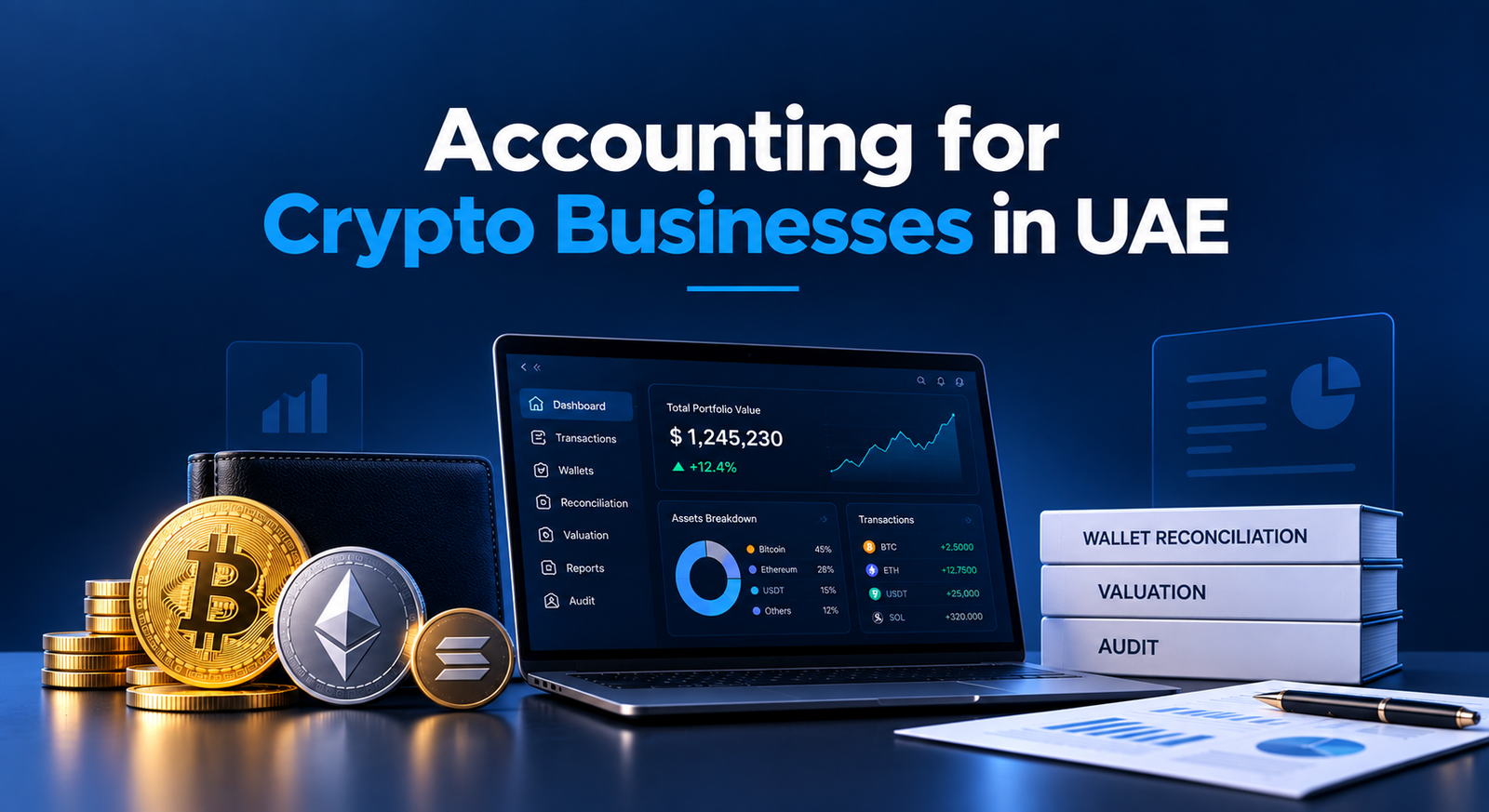
Crypto accounting in the UAE means reconciling every wallet and exchange account to an AED ledger, recording each token’s cost basis, applying a consistent valuation method and keeping customer assets separate from the company’s own. A crypto company registers for Corporate Tax, files 9 months after year end (30 September 2026 for December 2025 year ends) and keeps records for 7 years. Virtual asset transfers and conversions are VAT-exempt.
- Your UAE company holds, trades, custodies or accepts payment in virtual assets
- You are licensed or applying to VARA, or operate a crypto-related tech business
- Funds move between self-custody wallets, exchanges and bank accounts
- Investors, a bank or a regulator ask for audited or reconciled accounts
Not sure where you stand? Get a free 15-minute review or ask us on WhatsApp.
Which accounting and tax rules apply to crypto businesses in the UAE?
A crypto company incorporated in the UAE registers for Corporate Tax whatever its revenue, and needs VAT registration if its taxable supplies, such as software or advisory fees, pass AED 375,000. Exempt virtual asset transfers do not count as taxable supplies. The table sets out the tests as of September 2026.
| Rule | Threshold | What it means for a crypto business |
|---|---|---|
| Corporate Tax registration | Every UAE company, including free zone companies | Register even if the company only holds tokens |
| Corporate Tax rate | 0% up to AED 375,000 of taxable income, 9% above | Trading gains and fees both feed taxable income |
| Qualifying Free Zone Person | Substance, audited statements, de minimis of the lower of AED 5M or 5% of revenue | Free zone status alone does not give 0% |
| Small Business Relief | Revenue up to AED 3M, periods ending by 31 Dec 2029 | Not available to a Qualifying Free Zone Person |
| Individual trading personally | Business turnover above AED 1M in a calendar year | Corporate Tax registration by 31 March of the next year |
| VAT registration | Taxable supplies above AED 375,000 (voluntary from AED 187,500) | Tech and advisory fees are taxable; token transfers are exempt |
| Audited statements for Corporate Tax | Revenue above AED 50M, or every Qualifying Free Zone Person | Plan the audit trail from the first transaction |
Your regulator can set its own reporting and audit expectations, so confirm them with VARA in Dubai, or with the relevant authority if you are licensed in ADGM or DIFC. The Corporate Tax guide for crypto businesses covers the return, and our VAT guide for crypto businesses covers the exemption.
How do you reconcile crypto wallets and exchanges and track cost basis?
Treat every wallet address and exchange account like a bank account: it has its own ledger account, and at each month end the on-chain or exchange balance, in units, must agree to the ledger. Every inflow and outflow is converted to AED at a documented rate on the transaction date.
Monthly wallet and exchange reconciliation
| Source | Evidence | Check |
|---|---|---|
| Self-custody wallets | Block explorer export by address | Units per token agree to the ledger |
| Exchange accounts | Exchange statement and trade history | Trades, fees and withdrawals all posted |
| Internal transfers | Transaction hashes on both sides | Out of one wallet equals into another, less network fee |
| Fiat on and off ramps | Bank statement and exchange fiat ledger | AED amounts match both records |
| Customer deposits | Customer sub-ledger and custody wallets | Customer liability equals assets held for customers |
Cost basis methods
Pick one cost method per class of asset, such as first in, first out or weighted average, record it in an accounting policy and apply it every period. Each acquisition is logged with date, units, AED cost and fees; each disposal draws cost from that pool. Without this, you cannot show what a gain actually was. Our guide to Corporate Tax and accounting standards explains why the policy must be consistent.
- Record network and exchange fees as part of cost or as an expense, consistently
- Log airdrops, staking rewards and tokens received for services at AED value on receipt
- Keep the pricing source (exchange or index) and time used for every conversion
- Tag each transaction with its purpose: trading, treasury, customer, payroll or supplier
Fair value or cost, customer assets and the audit trail: how should crypto be reported?
Under IFRS, crypto held for the company’s own use or investment is usually accounted for as an intangible asset at cost (or revalued where an active market exists), while a broker-trader holding tokens for sale in the ordinary course may measure them at fair value less costs to sell. The choice changes profit, so decide it with your accountant and auditor before year end.
Fair value vs cost at a glance
How unrealised movements are treated for Corporate Tax is a separate question to settle with your adviser before you file.
| Business model | Common treatment | Effect on the accounts |
|---|---|---|
| Holding tokens as long-term treasury | Intangible asset at cost less impairment | Gains recorded only on sale, falls recorded as impairment |
| Active market and revaluation policy | Intangible asset revalued | Upward movements mostly go to equity |
| Broker-trader holding for resale | Inventory at fair value less costs to sell | Movements go through profit each period |
| Customer tokens held in custody | Usually not the company’s asset | Disclosed and reconciled, not income |
Customer asset segregation
Customer tokens and fiat should sit in wallets and accounts separate from the company’s own treasury, with a customer sub-ledger that shows what each customer is owed. Reconcile total customer liabilities to assets held for customers at least monthly. Mixing them turns customer money into apparent company income and breaks both the regulator’s and the FTA’s audit trail.
An audit trail VARA and the FTA can follow
Every ledger entry should link to a transaction hash or exchange trade ID, an AED rate source and a business purpose. Keep KYC-linked customer records, wallet ownership evidence and signed policies with the books for 7 years. Our UAE audit guide explains what an auditor will test.
What does a monthly close look like for a crypto business?
A crypto company’s close starts on-chain and ends in AED statements, within 10 working days, and the same data drives the VAT 201, where taxable and exempt supplies are split, and the annual Corporate Tax return.
Need the return handled as well? Have your Corporate Tax return prepared and reviewed by the same team that keeps the books.
Export wallet and exchange data
Pull transaction histories for every wallet address and exchange account for the month, including fees and internal transfers.
Convert to AED and post
Apply your documented pricing source at transaction time, post acquisitions, disposals, fees, staking and customer movements, and tag each with its purpose.
Reconcile units and fiat
Agree token units per wallet and exchange to the ledger, and fiat balances to bank and exchange statements; clear unmatched transfers.
Update cost pools and valuation
Run the cost basis calculation for disposals, then apply your valuation policy to holdings at month end.
Reconcile customer assets
Match the customer sub-ledger to segregated wallets and accounts, and investigate any shortfall immediately.
Split VAT supplies
Separate taxable fees from exempt virtual asset transfers and apportion input VAT where costs serve both. At quarter end these figures form the VAT 201 on EmaraTax.
Report and archive
Produce the monthly P&L, balance sheet and holdings report, and archive exports with hashes. The twelve closes become the statements for the Corporate Tax return and audit.
What records should a crypto company keep?
Keep evidence linking every token movement to an AED value and a business purpose for at least 7 years for Corporate Tax, and be able to provide Arabic translations on request.
- List of company-controlled wallet addresses with proof of ownership
- Exchange statements and full trade histories
- Block explorer exports with transaction hashes
- Pricing source records for every AED conversion
- Cost basis schedule per token under your chosen method
- Customer sub-ledger and segregated wallet reconciliations
- Bank statements for fiat on and off ramps
- Client contracts and tax invoices for fees and services
- Accounting policy on valuation, fees and staking rewards
- VAT 201 returns, Corporate Tax return and audit files
Which tax deadlines apply to crypto companies in 2026 and 2027?
The next Corporate Tax deadline for a December 2025 year end is 30 September 2026, with VAT returns due by the 28th after each quarter for registered companies.
| Date | What is due | Applies to |
|---|---|---|
| Within 10 working days of month end | Wallet, exchange and customer asset reconciliations | Internal target |
| 30 September 2026 | Corporate Tax return and payment, year ended 31 December 2025 | Companies with December year ends |
| 28 October 2026 | VAT 201 for the quarter ending 30 September 2026 | VAT-registered companies on that quarter |
| 30 October 2026 | Appoint an e-invoicing Accredited Service Provider | Businesses with revenue of AED 50M or more |
| 31 March 2027 | Appoint an e-invoicing Accredited Service Provider | Businesses under AED 50M revenue |
| 1 July 2027 | E-invoicing go-live | Businesses under AED 50M revenue |
What penalties can a crypto business face for poor records?
A crypto company that cannot evidence its transactions faces AED 10,000 for missing Corporate Tax records (AED 20,000 for a repeat), and every return built on those records carries its own late or incorrect filing risk. Amounts are as of September 2026.
| Breach | Penalty | Legal basis |
|---|---|---|
| Corporate Tax records not kept | AED 10,000, repeat AED 20,000 | Cabinet Decision 75/2023 as amended |
| VAT records not kept | AED 10,000 for a first violation | Cabinet Decision 129/2025 |
| Arabic translation not produced on request | AED 5,000 | Cabinet Decision 129/2025 |
| Late Corporate Tax return | AED 500 a month for 12 months, then AED 1,000 a month | Cabinet Decision 75/2023 as amended |
| Late Corporate Tax registration | AED 10,000, waived if the first return is filed within 7 months of the first period end | Cabinet Decision 75/2023 as amended |
| Late VAT 201 | AED 1,000, repeat within 24 months AED 2,000 | Cabinet Decision 129/2025 |
| Incorrect VAT 201 | AED 500, repeat AED 2,000 | Cabinet Decision 129/2025 |
| Late payment of tax | 14% a year, calculated monthly | Cabinet Decisions 129/2025 and 75/2023 |
How it stacks: a crypto company files its 2025 return 6 months late with AED 30,150 of Corporate Tax unpaid. Late filing adds AED 3,000 (AED 500 x 6) and late payment adds about AED 2,111 (AED 30,150 x 14% / 12 x 6), before a possible AED 10,000 if the FTA finds the wallet records incomplete.
Wallets never reconciled to your ledger?
We check your wallet reconciliations, cost basis and customer asset records before the Corporate Tax return on 30 September 2026.
7 accounting mistakes crypto business owners make
These are the gaps we find most often when a crypto company’s first year end arrives.
- No cost basis records. Disposals cannot be matched to acquisitions, so gains cannot be evidenced and the Corporate Tax computation has no support.
- Internal transfers booked as income or expenses. Moving tokens between your own wallets inflates revenue and costs.
- Customer assets mixed with treasury. Customer deposits look like company income and the regulator’s segregation requirement is breached.
- Receipts in crypto not converted at the transaction date. Revenue in AED is wrong and cannot be reproduced.
- Assuming a free zone licence means 0% tax. Without meeting the Qualifying Free Zone Person conditions, income is taxed at 9% above AED 375,000.
- Treating all supplies as VAT-exempt. Software, advisory and listing fees are taxable, so the VAT 201 is incorrect.
- Owner’s personal wallet used for company payments. The company can no longer prove which assets and costs are its own.
How can a crypto company keep its books and returns penalty-free?
Run crypto bookkeeping on the same monthly rhythm as a bank-based business, with extra controls for wallets and customers. The UAE bookkeeping guide covers the baseline record rules.
- Use company-controlled wallets and a business bank account, never personal ones
- Monthly: reconcile every wallet, exchange and bank account in units and AED
- Monthly: close within 10 working days with cost pools updated
- Monthly: reconcile customer liabilities to segregated assets
- Quarterly: accountant review of taxable versus exempt supplies before the VAT 201
- Annually: confirm valuation policy and Qualifying Free Zone Person position before year end
- Annually: agree audit scope and evidence format with the auditor early
- Always: keep records 7 years with Arabic translations available on request
Crypto books incomplete or an FTA notice received?
Reconstruct the history from exchange exports, block explorer data and bank statements, rebuild cost pools from the earliest acquisition you can evidence, agree opening balances, then file overdue returns. Our catch-up bookkeeping guide shows the sequence, and the missed Corporate Tax deadline guide covers the late return.
- Correct VAT 201 errors, such as taxable fees reported as exempt, with a voluntary disclosure (1% a month before an audit notice)
- If an audit notice has already arrived, the disclosure penalty is 15% plus 1% a month
- Request reconsideration within 40 business days of a penalty decision you disagree with
- Escalate a refused reconsideration to the Tax Disputes Resolution Committee
Our FTA reconsideration guide explains the process. No outcome is certain, but a reconciled on-chain trail is the strongest evidence a crypto company can present.
FTA notice or a missed return for your crypto company?
Send us the notice and we will tell you what records to rebuild and what to file first.
Worked example: what missing cost basis records can cost
An illustrative Dubai virtual asset broker earns AED 2,400,000 of fees in 2025 against AED 1,900,000 of expenses, and does not elect Small Business Relief. It sold treasury tokens for AED 520,000 that, on a first in, first out basis, cost AED 310,000. Its books were never reconciled, and the acquisition records sit in an exchange account it has since closed.
| Line | Cost basis evidenced | Cost basis missing |
|---|---|---|
| Fee income less expenses | AED 500,000 | AED 500,000 |
| Token sale proceeds | AED 520,000 | AED 520,000 |
| Cost of tokens sold | AED 310,000 | No documented cost |
| Profit | AED 710,000 | AED 1,020,000 |
| Corporate Tax: 9% above AED 375,000 | AED 30,150 | AED 58,050 |
| Exposure: Corporate Tax records not kept | Avoided | AED 10,000 |
| Exposure: return 6 months late | Avoided | AED 3,000 |
The AED 27,900 gap is what an undocumented cost basis can put at stake, plus the penalties. A catch-up across wallets and exchanges is a one-off project sized by transaction volume; kept monthly, Paci’s bookkeeping starts from AED 599 a month (AED 7,188 a year), quoted as a fixed fee.
Should a crypto company do its own accounting, use a freelancer or hire a firm?
A founder with a few wallets can keep records with good tooling, a freelancer with crypto experience suits a small trading company, and a firm suits licensed or customer-facing businesses that need reconciliations, VAT splits and audit support.
| Option | Cost | Founder time | Risk | Suits |
|---|---|---|---|---|
| Founder with crypto tax software | Software subscription plus your time | High | Software output never tied to a ledger or AED statements | Early-stage, few wallets, no customers |
| Freelance accountant with crypto experience | Typical market range: varies with wallets and volume | Medium | Hard to find, limited audit support | Small proprietary trading companies |
| Accounting firm (Paci) | From AED 599 a month, fixed quote within 24 hours | Low | Qualified accountant reviews each quarter | Licensed brokers, custodians and crypto tech firms |
Read what to check when outsourcing and how bookkeeping is priced, then see our accounting and bookkeeping service.
What crypto founders ask us about their accounts
If I trade my own crypto and stock funds through a free zone company and pay myself a salary, how is that taxed?
The company registers and files Corporate Tax. A salary paid to you as owner must be at arm’s length and disclosed with the return. Trading income is not automatically 0% because the company is in a free zone: the Qualifying Free Zone Person conditions still apply. Our transfer pricing guide explains arm’s length pay.
My free zone tech company will be paid in crypto and I do not plan to open a UAE bank account. How do I keep books that stand up?
Record each receipt at its AED value on the day received, issue invoices for your services, and keep wallet records and invoices together for 7 years for Corporate Tax. Transfers and conversions of virtual assets are VAT-exempt under Cabinet Decision 100/2024, but the tech services you sell are not. A business bank account also makes the audit trail far easier.
Banks keep asking about my crypto history. What records should I have ready?
Exchange statements, the wallet addresses you control, and a transaction ledger tying each transfer to an AED value and a purpose. For a company, those same records are part of the 7-year Corporate Tax record requirement, so building them once serves both.
We trade forex and US stocks from our own fund and want to run it through a Dubai free zone company remotely. What comes with that?
Annual Corporate Tax registration and filing. The free zone 0% rate needs adequate substance in the UAE and audited financial statements, which is hard to demonstrate if the company is run entirely from abroad.
I am moving from India to start a company covering IT services and crypto. What do I need on the tax side?
The company registers for Corporate Tax whatever its revenue, and for VAT once taxable supplies pass AED 375,000. Virtual asset transfers and conversions are VAT-exempt, so keep them separate from IT service sales in the books. Our technology sector VAT and Corporate Tax guide covers the service side.
Frequently asked questions
What is crypto accounting in the UAE?+
It is the bookkeeping that turns wallet and exchange activity into AED financial statements: reconciling units and balances, tracking cost basis, valuing holdings under IFRS, separating customer assets and splitting taxable and exempt supplies for VAT, all kept for 7 years for Corporate Tax.
Is crypto taxed under UAE Corporate Tax?+
Gains, fees and other income of a UAE crypto company form part of its taxable income, taxed at 0% up to AED 375,000 and 9% above. Individuals investing personally without a business are treated differently. Our guide to the AED 1 million rule covers individuals running a business.
Is VAT charged on crypto transactions in the UAE?+
Transfers and conversions of virtual assets are VAT-exempt under Cabinet Decision 100/2024, applied from 1 January 2018. Fees for software, advisory or other services remain taxable at 5%, and input VAT linked to exempt supplies is generally not recoverable. See VAT for financial services.
How do you value crypto on a UAE balance sheet?+
Under IFRS most holdings are intangible assets at cost less impairment, or revalued where an active market exists, while broker-traders may use fair value less costs to sell. Pick the policy that matches your business model and apply it consistently.
Do crypto companies in Dubai need an audit?+
Corporate Tax requires audited statements above AED 50 million revenue and for every Qualifying Free Zone Person under Ministerial Decision No. 84 of 2025. Your regulator may set its own requirement, so confirm it with VARA or your licensing authority.
What software do crypto businesses use for bookkeeping?+
Usually a crypto sub-ledger tool that imports wallet and exchange data, feeding a VAT-ready general ledger. The sub-ledger totals must still be reconciled to on-chain balances monthly. Our bookkeeping guides by industry show setups for other sectors.
Get your crypto company's books reviewed for free
In a free 15-minute review a qualified accountant checks one month of your wallet reconciliations, cost basis records and VAT split and lists what an FTA review or audit would flag. You get a fixed quote within 24 hours, with bookkeeping from AED 599 a month.
- A free 15-minute review with a qualified accountant
- A fixed quote within 24 hours, no hourly billing
- We reply on WhatsApp or email, whichever you prefer
Continue on WhatsApp now →
- Ministry of Finance: Ministerial Decision No. 84 of 2025 on Audited Financial Statements
- FTA: Registration for VAT
- FTA: Waiver of penalties
- MoF: Cabinet Decision No. 40 of 2017 and amendments
Checked against these sources on 15 September 2026. This guide is general information for UAE businesses, not advice on your specific facts.