
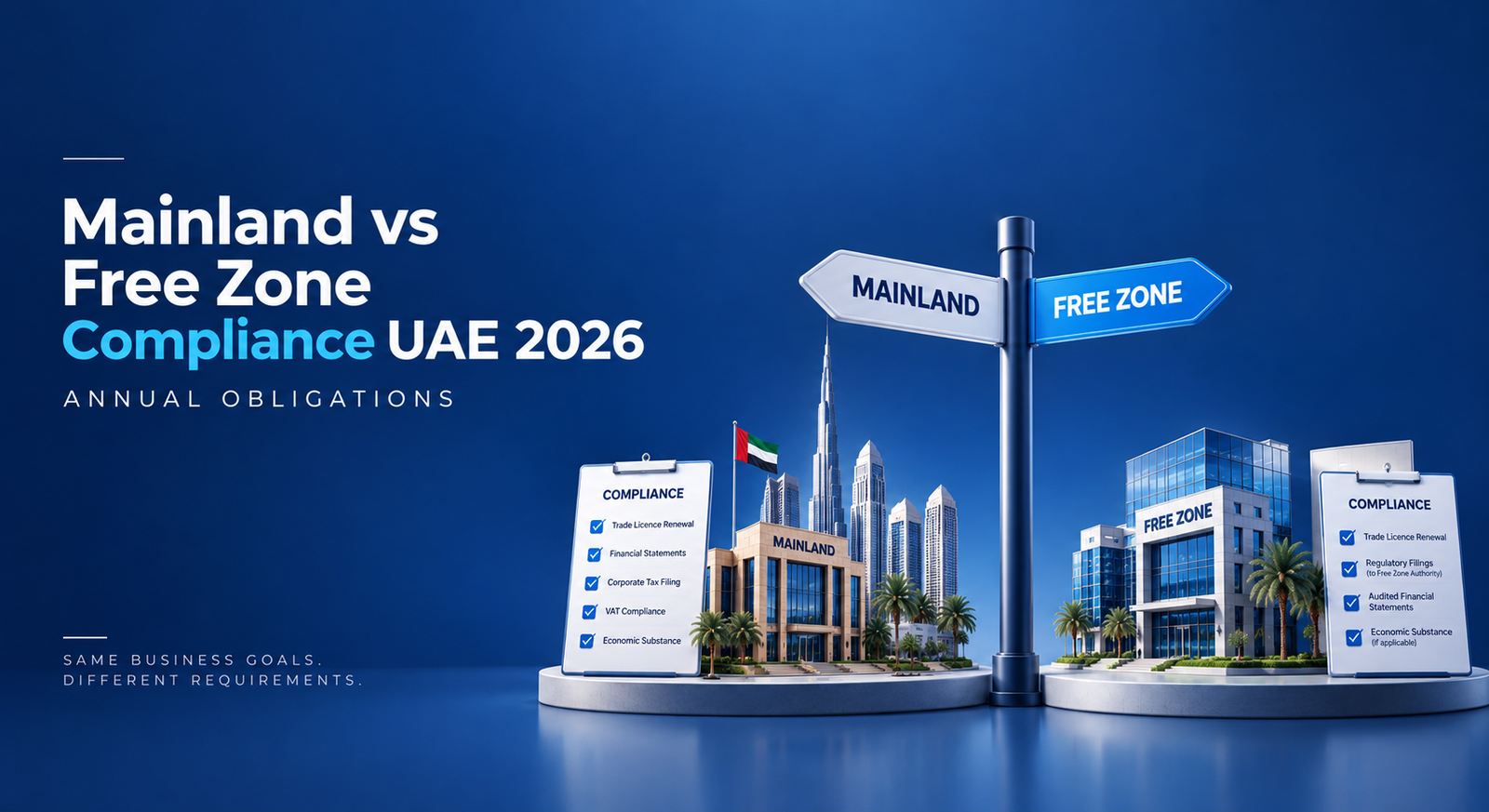
Mainland and free zone companies share the core 2026 obligations: licence renewal, UBO registers, Corporate Tax registration and an annual return (due 30 September 2026 for December 2025 year ends), VAT above AED 375,000 and e-invoicing. A mainland LLC must also elect an auditor every year and follow MoHRE, WPS and Emiratisation rules, while a free zone company follows its zone’s audit and employment rules and can seek the 0% QFZP rate.
- You own or manage a UAE mainland LLC or a free zone company that is already trading
- You are choosing between a mainland and a free zone licence and want to know the running obligations
- Your licence, visas or Corporate Tax return are coming up for renewal or filing
- You employ staff through MoHRE or through a free zone authority
Not sure where you stand? Get a free 15-minute review or ask us on WhatsApp.
Which compliance rules apply to your mainland or free zone company?
Almost every tax rule applies to both mainland and free zone companies; the differences sit in company law, labour and visas, and the free zone authority’s own conditions. Find your business type in the table.
If you are still choosing a licence, our mainland vs free zone setup guide covers market access and cost. This post is about what you must do every year once you trade.
| Business type | Corporate Tax | VAT | Audit | Labour and visas |
|---|---|---|---|---|
| Mainland LLC | Register and file; 9% above AED 375,000 | Register once taxable supplies pass AED 375,000 | Auditor elected every year under the Commercial Companies Law | MoHRE, WPS and Emiratisation targets |
| Free zone company | Register and file; 0% possible as a Qualifying Free Zone Person | Same thresholds; goods in designated zones can be outside scope | Set by the zone; required for every QFZP | Zone authority; DIFC and ADGM have their own employment rules |
| Branch of a foreign company | Register and file | Same thresholds | Confirm with the licensing authority | Depends on where it is licensed |
| Individual trading under a licence | Only once business turnover passes AED 1 million in a calendar year | Same thresholds | No company law audit | Depends on the licence |
| Company with revenue up to AED 3 million | Can elect Small Business Relief, but still registers and files | Same thresholds | As for its licence type | As for its licence type |
Economic Substance Regulations notifications and reports no longer apply for financial years starting on or after 1 January 2023 under Cabinet Decision 98 of 2024, for mainland and free zone companies alike. Our Economic Substance Regulations guide covers the older years.
Mainland vs free zone company obligations in 2026: the full table
The table lists every recurring obligation we track for UAE companies, as of September 2026. The right-hand column shows what happens if it is missed; amounts are covered in the penalties section below.
Where a rule depends on the emirate or the zone, the cell says to confirm it with the authority.
| Obligation | Mainland company | Free zone company | If you miss it |
|---|---|---|---|
| Trade licence renewal | Annual, with the emirate’s licensing authority (the Department of Economy and Tourism in Dubai) | Annual, with the zone authority; many zones ask for financial statements first | Late renewal fines; an expired licence blocks the establishment card and visas |
| Establishment card | Renewed to keep sponsoring visas | Issued through the zone and renewed | Visa applications and renewals blocked |
| Office lease | Registered tenancy contract, Ejari in Dubai (confirm the rule for your activity) | Office, flexi desk or warehouse lease from the zone | Renewal blocked without a valid lease |
| UBO registers | Keep registers and report changes within 15 days (Cabinet Decision 109 of 2023) | Same; confirm the process with your registrar in DIFC or ADGM | Warning, then fines of AED 50,000 up to AED 100,000 and possible suspension |
| Corporate Tax | Register and file every year; 9% above AED 375,000 | Same, plus the 0% QFZP option on qualifying income | Late registration AED 10,000; late return AED 500 a month, then AED 1,000 |
| Small Business Relief | Elective up to AED 3 million revenue, for tax periods ending on or before 31 December 2029 | Available, but not to a Qualifying Free Zone Person | Standard rules apply if not elected |
| VAT | Register above AED 375,000; return by the 28th after each period | Same; goods in designated zones can be outside scope, services are always taxable | Late registration AED 10,000; late return AED 1,000, then AED 2,000 |
| Audited accounts | LLC elects an auditor every year (Article 102); general assembly within 4 months of year end (Article 92) | Set by each zone; see the zone by zone audit guide | Zone: renewal blocked. QFZP: 9% for that period and the next 4 |
| Corporate Tax audit rule | Audited statements if revenue is above AED 50 million (not a tax group) | Audited statements if revenue is above AED 50 million, or if a QFZP | QFZP status lost; records and return penalties |
| Economic Substance | Not required for financial years from 1 January 2023 | Not required; QFZP substance conditions still apply | Not applicable |
| AML and goAML | DNFBPs register on goAML, the Financial Intelligence Unit’s platform, and report (Federal Decree-Law No. 10 of 2025) | Same | Suspension of operations and fines |
| Labour and WPS | MoHRE work permits; wages through WPS by the 1st of the following month (Ministerial Resolution No. 340 of 2026) | Zone work permits; DIFC and ADGM run their own employment laws | AED 1,000 per worker paid late or outside WPS, capped at AED 20,000 |
| Emiratisation | 50 or more employees: grow skilled Emirati staff each year; 20 to 49 employees in 14 sectors: one Emirati hire each in 2024 and 2025 | Generally outside MoHRE targets unless registered with MoHRE; confirm | AED 10,000 a month per unfilled role from 1 July 2026 |
| E-invoicing | Appoint a provider by 30 October 2026 (revenue AED 50 million or more) or 31 March 2027 | Same | AED 5,000 a month without a provider |
| ICV certificate | Optional; scored in ADNOC and many government tenders | Same | Lower tender score or exclusion |
| Records | 7 years for Corporate Tax | Same | AED 10,000, or AED 20,000 for a repeat |
Licence renewal, UBO registers and audited accounts: where the rules differ
The licence and UBO duties are nearly identical for both licence types; audited accounts are where mainland and free zone companies part ways.
Trade licence and establishment card
A mainland licence renews each year with the emirate’s licensing authority, while a free zone licence renews with the zone, which often asks for financial statements and a valid lease first. Let either lapse and the establishment card cannot be renewed, which stops visa renewals for you and your staff.
Dubai mainland licences are normally tied to a registered tenancy contract (Ejari); confirm the office rule for your activity with the licensing authority. Late renewal fines accrue on both the licence and the establishment card, so renew the licence first and the card straight after.
UBO registers for mainland and free zone companies
Under Cabinet Decision 109 of 2023, companies keep a register of beneficial owners, a register of shareholders or partners and, where relevant, a register of nominee directors, and notify changes within 15 days. Penalties under Cabinet Decision 132 of 2023 start with a written warning and rise to fines of AED 50,000 and up to AED 100,000, with possible licence suspension. Our UBO register guide explains each register.
Audited accounts: Commercial Companies Law vs free zone rules
For a mainland LLC, Federal Decree-Law No. 32 of 2021 is direct: Article 102 requires one or more auditors elected by the partners’ general assembly every year, and Article 92 requires that general assembly to meet at least once a year within 4 months after the financial year end. Whether the licensing authority asks for the audited accounts at renewal depends on the emirate, so confirm with the authority.
Free zone rules differ zone by zone: IFZA accepts simplified statements from small companies, DIFC and ADGM exempt some small companies, and RAK ICC has no statutory audit. Our free zone audit requirements by zone sets out 22 zones. On top of both, Ministerial Decision No. 84 of 2025 requires audited statements from every Qualifying Free Zone Person and from non-group businesses with revenue above AED 50 million.
Corporate Tax, VAT and e-invoicing: the same rules with one free zone exception
Corporate Tax, VAT and e-invoicing rules are federal, so they apply in the same way to mainland and free zone companies; the one real difference is the 0% rate available to a Qualifying Free Zone Person.
Corporate Tax registration and the annual return
Every company registers for Corporate Tax whatever its revenue and files a return 9 months after its financial year end, even with zero revenue: 30 September 2026 for December 2025 year ends. The rate is 0% up to AED 375,000 of taxable income and 9% above it. Late registration costs AED 10,000, waived if the first return is filed within 7 months of the end of the first tax period.
Small Business Relief is elective for resident businesses with revenue up to AED 3 million and now runs to tax periods ending on or before 31 December 2029. It is not the same as the AED 375,000 band. See our Small Business Relief guide, and if your company has not traded, our nil Corporate Tax return guide.
The free zone exception: Qualifying Free Zone Person status
A free zone company can pay 0% on qualifying income if it keeps adequate substance, keeps non-qualifying revenue within the lower of AED 5 million or 5% of revenue, complies with transfer pricing rules, prepares audited financial statements and does not elect the standard rate. Income from mainland customers and individuals is generally non-qualifying. Failing a condition means 9% for that period and the next 4. Read our Qualifying Free Zone Person guide before you rely on it.
VAT and designated zones
VAT registration is mandatory once taxable supplies and imports pass AED 375,000 in 12 months, and voluntary from AED 187,500, for both licence types. Designated zones can take supplies of goods outside VAT, but services there are always taxable at the standard rate. Registering late costs AED 10,000 plus the output VAT you should have charged; our late VAT registration guide explains the fix.
E-invoicing phases
Businesses with revenue of AED 50 million or more must appoint an Accredited Service Provider by 30 October 2026 and go live on 1 January 2027. Businesses under AED 50 million appoint by 31 March 2027 and go live on 1 July 2027. Our e-invoicing guide for SMEs covers choosing a provider.
Labour, WPS, Emiratisation and AML: where mainland and free zone rules split
Labour is where mainland and free zone companies differ most: mainland employers work through MoHRE, WPS and Emiratisation targets, while free zone employers follow their zone’s permit system.
MoHRE and WPS for mainland employers
Since 1 June 2026, Ministerial Resolution No. 340 of 2026 sets the Wage Protection System rules. Wages are due by the 1st of the following month, with no grace period, and a company counts as compliant when at least 85% of its workers are paid on time. Paying a worker late or outside WPS costs AED 1,000 per worker, capped at AED 20,000. See our WPS guide or our WPS compliance service.
Free zone employment
Free zone companies obtain work permits and visas through the zone authority; confirm with your zone how WPS applies to your staff. DIFC and ADGM run their own employment laws, and DIFC employers pay into the DEWS savings scheme at 5.83% of basic wage for the first 5 years of service and 8.33% after that.
Emiratisation targets in 2026
Mainland companies with 50 or more employees must increase Emiratis in skilled roles each year, with half of the yearly increase due by 30 June. MoHRE confirmed in June 2026 that from 1 July 2026 it collects AED 10,000 a month (AED 120,000 a year) for each role not filled. Companies with 20 to 49 employees in 14 economic sectors had to hire one UAE citizen in 2024 and another in 2025.
Free zone companies whose staff are not registered with MoHRE are generally outside these targets; confirm with MoHRE and your zone. Our Emiratisation guide explains how headcount is counted.
AML and goAML registration
Federal Decree-Law No. 10 of 2025, in force since 14 October 2025, and its executive regulation, Cabinet Resolution No. 134 of 2025, now set the AML rules. Designated non-financial businesses and professions, including real estate agents, dealers in precious metals and stones, auditors and corporate service providers, must register on goAML, the UAE Financial Intelligence Unit’s reporting platform, and report suspicious transactions, whether mainland or free zone. Registration is enforced: in 2023 the Ministry of Economy suspended 50 such businesses for 3 months for failing to register. Our AML compliance guide covers the duties.
ICV certificates
An In-Country Value certificate is not a legal filing, but ADNOC and many government and semi-government buyers score or require it in tenders. If you bid for that work, plan it into your annual calendar; our ICV certificate service explains the process.
How to build your company's annual compliance calendar
A one-page calendar owned by one person prevents most penalties. Build it in this order.
List every obligation
Licence, establishment card, lease, UBO registers, Corporate Tax, VAT, audit, WPS, Emiratisation, goAML if you are a DNFBP, e-invoicing and ICV, each with a named owner.
Anchor dates to your year end and licence date
Corporate Tax return 9 months after year end, LLC general assembly within 4 months, zone audit by the zone deadline, licence and card on the anniversary.
Confirm which labour regime you are under
MoHRE and WPS for mainland employers; the zone authority’s rules for free zones; DIFC and ADGM employment laws where relevant.
Add activity-specific duties
Register on goAML if you are a DNFBP, and add the ICV certificate if you bid for ADNOC or government contracts.
Record your Corporate Tax elections
Decide Small Business Relief, QFZP or the standard rate, and whether Ministerial Decision No. 84 of 2025 requires an audit.
Plan e-invoicing
Check your revenue band and diarise the provider deadline: 30 October 2026 or 31 March 2027.
Review every quarter
Update UBO records within 15 days of any change and run a compliance check 60 days before each licence renewal.
What to keep in your company compliance file
Keep one file, digital or physical, with the current version of each document below.
- Trade licence, memorandum of association and any amendments
- Establishment card and a list of visas sponsored
- Tenancy contract or zone lease
- Registers of beneficial owners, shareholders and nominee directors
- Corporate Tax registration certificate, filed returns and elections
- VAT certificate, filed VAT 201 returns and tax invoices
- Audited or management accounts and the general assembly minutes
- WPS salary files and MoHRE or zone work permit records
- goAML registration confirmation, if you are a DNFBP
- E-invoicing provider agreement once appointed
Compliance dates from September 2026 to July 2027
These are the fixed dates for a company with a 31 December year end filing VAT on calendar quarters; add your licence anniversary and zone audit date.
| Date | What is due | Who |
|---|---|---|
| 30 September 2026 | Corporate Tax return and payment for December 2025 year ends | Mainland and free zone companies |
| 28 October 2026 | VAT return for July to September 2026 | Calendar quarter VAT filers |
| 30 October 2026 | E-invoicing Accredited Service Provider appointed | Revenue of AED 50 million or more |
| 31 December 2026 | Full-year Emiratisation target for skilled roles | Mainland employers with 50 or more employees |
| 1 January 2027 | E-invoicing go-live | Revenue of AED 50 million or more |
| 28 January 2027 | VAT return for October to December 2026 | Calendar quarter VAT filers |
| 31 March 2027 | E-invoicing Accredited Service Provider appointed | Revenue under AED 50 million |
| 30 April 2027 | General assembly for the 2026 financial year | Mainland LLCs with a 31 December year end |
| 1 July 2027 | E-invoicing go-live | Revenue under AED 50 million |
| Within 15 days of a change | UBO register update | Mainland and free zone companies |
| Licence anniversary | Licence and establishment card renewal; zone audit if required | Mainland and free zone companies |
| By the 1st of each month | Previous month’s wages paid through WPS | MoHRE-registered employers |
Compliance penalties for mainland and free zone companies in 2026
The tax penalties are identical for both licence types; labour and Emiratisation charges mainly hit mainland employers. Figures as of September 2026.
| Violation | Penalty | Applies to |
|---|---|---|
| Late Corporate Tax registration | AED 10,000, waived if the first return is filed within 7 months of the end of the first tax period | Both |
| Late Corporate Tax return | AED 500 a month for the first 12 months, then AED 1,000 a month | Both |
| Late Corporate Tax or VAT payment | 14% a year, calculated monthly | Both |
| Late VAT registration | AED 10,000 plus backdated output VAT | Both |
| Late VAT return | AED 1,000 first time, AED 2,000 repeat within 24 months | Both |
| UBO registers not kept or updated | Warning, then fines of AED 50,000 up to AED 100,000 and possible suspension | Both |
| Wages paid late or outside WPS | AED 1,000 per worker, capped at AED 20,000 | MoHRE-registered employers |
| Emiratisation target missed (50 or more employees) | AED 10,000 a month per unfilled role from 1 July 2026 | Mainland employers |
| No e-invoicing provider once your phase applies | AED 5,000 a month | Both |
| Corporate Tax records not kept | AED 10,000, or AED 20,000 for a repeat | Both |
| QFZP without audited statements | 9% Corporate Tax for that period and the next 4 | Free zone companies |
| DNFBP not registered on goAML | Suspension of operations and fines | Both |
How it stacks: a mainland LLC that files its Corporate Tax return 3 months late (AED 500 x 3 = AED 1,500) and misses one VAT return for the first time (AED 1,000) owes AED 2,500 in fixed penalties before any late payment charge at 14% a year and before a single Emiratisation or WPS charge.
Not sure which obligations you have already missed?
We map your licence, tax, UBO and labour obligations against the 2026 dates and flag anything overdue.
7 compliance mistakes owners make after company setup
Most penalties we see come from one of these assumptions.
- Thinking a free zone company does not need Corporate Tax. Every company registers and files; missing registration costs AED 10,000 and the late return adds AED 500 a month.
- Believing mainland LLCs never need an auditor. Article 102 of the Commercial Companies Law requires one elected every year, and banks and authorities can ask for the accounts.
- Still preparing Economic Substance filings for 2023 onward. ESR ended for those years, and the time is taken from deadlines that do carry penalties.
- Letting the licence lapse. The establishment card and visas are blocked until it is renewed, and fines keep running.
- Forgetting the UBO update after a partner change. The 15 day window passes quickly, and repeat breaches reach AED 50,000 or more.
- Missing the Emiratisation milestones. From 1 July 2026 each unfilled role costs AED 10,000 a month for mainland employers with 50 or more staff.
- Using the old 31 July 2026 e-invoicing date. The deadline for AED 50 million revenue is now 30 October 2026, and smaller businesses have until 31 March 2027, so plans built on the old date misallocate budget and time.
Monthly, quarterly and annual compliance routine for UAE companies
Split the calendar into three rhythms and give each one an owner.
- Monthly: pay wages through WPS by the 1st of the following month
- Monthly: reconcile bank accounts and file supplier invoices for VAT
- Monthly: note any change in owners, partners or managers and update UBO records within 15 days
- Quarterly: file the VAT return by the 28th of the following month
- Quarterly: check Emiratisation headcount against the half-year and full-year targets
- Quarterly: review goAML reporting if you are a DNFBP
- Annually: hold the LLC general assembly within 4 months of year end and elect the auditor
- Annually: file the Corporate Tax return 9 months after year end
- Annually: renew the licence, lease and establishment card, with the zone audit if required
Behind on filings, licence renewal or an FTA notice?
Fix the licence first, because an expired licence blocks everything else, then file the overdue tax returns and correct any errors.
For Corporate Tax, file the late return now: the penalty grows by AED 500 each month for the first year. Our missed Corporate Tax deadline guide sets out the first 7 days, and our catch-up bookkeeping guide helps if the books are behind.
If a filed return is wrong, a voluntary disclosure before any audit notice carries a penalty of 1% a month, far lower than the 15% plus 1% a month that applies after one.
If you receive a penalty you believe is wrong, request reconsideration from the FTA within 40 business days, then escalate to the Tax Disputes Resolution Committee. The FTA reconsideration request guide shows how to apply.
Got an FTA notice or a blocked licence?
Send us the notice or the portal message and we will tell you what to fix first.
Worked example: how missed obligations add up for a mainland LLC
Take an illustrative Dubai mainland trading LLC with 60 employees and a 31 December year end that let four obligations slip.
| Missed obligation | Penalty (AED) | How it is worked out |
|---|---|---|
| 2024 Corporate Tax return filed 3 months late | 1,500 | AED 500 x 3 months |
| One quarterly VAT return filed late, first time | 1,000 | Fixed penalty under Cabinet Decision 129/2025 |
| One skilled role left unfilled from July to December 2026 | 60,000 | AED 10,000 x 6 months |
| Wages for 4 workers paid late, outside WPS | 4,000 | AED 1,000 x 4 workers |
| Total | 66,500 | 1,500 + 1,000 + 60,000 + 4,000 |
The same business in a free zone, with staff employed through the zone rather than MoHRE, would generally avoid the Emiratisation charge. It would instead risk a blocked renewal if its zone audit was missing, and 9% Corporate Tax for 5 periods if it claimed QFZP status without audited statements.
Track compliance yourself, split it between a PRO and a freelancer, or use one firm?
Compliance fails at the handovers between people, so the question is who sees the whole calendar. Compare the options.
| Option | Cost | Your time | Risk | Suits |
|---|---|---|---|---|
| Owner tracks everything | No extra fee | High: every portal, deadline and renewal | One missed date blocks visas or triggers monthly penalties | Single-owner companies with no staff |
| PRO for licences plus a freelance bookkeeper | Typical market rates, paid to two providers | Medium | Tax, UBO and licence dates held by different people, with gaps between them | Small companies with simple tax positions |
| Accounting firm with a compliance calendar | Fixed quote; Paci bookkeeping from AED 599 a month | Low | Lower: tax, audit and calendar reviewed together | Companies with staff, VAT, audits or QFZP status |
Our compliance review service maps every obligation for your licence type, flags anything overdue and sets up the calendar, with a fixed quote within 24 hours. For the tax filings themselves, see our Corporate Tax filing service.
What company owners ask us about annual compliance
My mainland licence expired, I renewed it after converting to an LLC, but my establishment card is still blocked. What now?
An expired licence blocks the establishment card, and fines can accrue on both while they are expired. After renewing, apply to update or renew the establishment card with immigration, pay any outstanding fines and provide what they request; a PRO can check the exact reason for the block.
Beyond the licence fee, what does it cost each year to keep a UAE company compliant?
Budget for Corporate Tax registration and an annual return, VAT once taxable supplies pass AED 375,000, monthly bookkeeping, an audit (a mainland LLC elects an auditor every year; most free zones want statements at renewal), and establishment card and visa renewals. Mainland employers with 50 or more staff must also plan for Emiratisation.
We are setting up an LLC with three partners and little revenue at first. What must we do every year?
Register for Corporate Tax and file every year even with no revenue, keep the UBO and partner registers and update them within 15 days of any change, elect an auditor and hold the general assembly within 4 months of year end, and renew the licence and establishment card on time. Register for VAT once taxable supplies pass AED 375,000.
Do free zone companies have to meet Emiratisation targets?
The MoHRE targets apply to employers registered with MoHRE, which is mainly mainland companies. Free zone companies that hire through their zone authority are generally outside them, but confirm with MoHRE and your zone, especially if you also hold a mainland licence or MoHRE-registered staff.
Is Economic Substance reporting still needed in 2026?
No. Cabinet Decision 98 of 2024 ended ESR obligations for financial years starting on or after 1 January 2023, and penalties for those later years were waived. Substance still matters for a free zone company claiming Qualifying Free Zone Person status under Corporate Tax.
Frequently asked questions
What are the annual compliance requirements for a free zone company in the UAE?+
A free zone company renews its licence, lease and establishment card, keeps UBO registers, registers for Corporate Tax and files a return every year, registers for VAT above AED 375,000 and prepares for e-invoicing. Most zones also want audited or simplified statements at renewal, and a Qualifying Free Zone Person must have audited statements. See our free zone audit guide.
What are the annual compliance requirements for a mainland company in the UAE?+
A mainland LLC renews its licence and establishment card, keeps UBO registers, elects an auditor and holds a general assembly within 4 months of year end, files Corporate Tax and VAT returns, pays salaries through WPS, meets Emiratisation targets if it has 20 or more staff in covered sectors, and appoints an e-invoicing provider on time.
Is an audit mandatory for a mainland LLC in the UAE?+
Yes. Article 102 of Federal Decree-Law No. 32 of 2021 requires every limited liability company to have one or more auditors elected by the general assembly each year. Corporate Tax separately requires audited statements from non-group businesses with revenue above AED 50 million under Ministerial Decision No. 84 of 2025.
Do free zone companies pay Corporate Tax in the UAE?+
Every free zone company must register and file. It pays 9% on taxable income above AED 375,000 unless it qualifies as a Qualifying Free Zone Person, which pays 0% on qualifying income if it meets substance, audit, de minimis and transfer pricing conditions. Small Business Relief is not available to a QFZP.
How quickly must a UAE company update its UBO register?+
Changes to beneficial ownership must be notified within 15 days under Cabinet Decision 109 of 2023. A first breach usually brings a written warning, and later breaches can bring fines of AED 50,000 and up to AED 100,000 with possible licence suspension. Our UBO register guide explains the registers.
When does e-invoicing become mandatory for UAE companies?+
Businesses with revenue of AED 50 million or more must appoint an Accredited Service Provider by 30 October 2026 and go live on 1 January 2027. All other businesses appoint a provider by 31 March 2027 and go live on 1 July 2027. The rules are the same for mainland and free zone companies.
Which businesses must register on goAML in the UAE?+
Designated non-financial businesses and professions must register on goAML, the UAE Financial Intelligence Unit’s reporting platform, under Federal Decree-Law No. 10 of 2025. They include real estate agents and brokers, dealers in precious metals and stones, auditors and accountants, and corporate service providers. The duty is the same for mainland and free zone companies.
Get your company's compliance calendar reviewed for free
In a free 15-minute review a qualified accountant checks your licence type, Corporate Tax and VAT position, audit rule and upcoming deadlines. You get a fixed quote within 24 hours for ongoing compliance, bookkeeping or filing.
- A free 15-minute review with a qualified accountant
- A fixed quote within 24 hours, no hourly billing
- We reply on WhatsApp or email, whichever you prefer
Continue on WhatsApp now →
- Federal Decree-Law No. 32 of 2021 on Commercial Companies (Ministry of Economy)
- Ministry of Finance: Ministerial Decision No. 84 of 2025 on Audited Financial Statements
- Ministry of Finance: amendments to eInvoicing system decisions
- UAE Legislation: Cabinet Resolution No. 109 of 2023 on beneficial owners
- u.ae: Payment of wages
- MoHRE: Emiratisation targets for companies with 20 to 49 employees
Checked against these sources on 15 September 2026. This guide is general information for UAE businesses, not advice on your specific facts.