
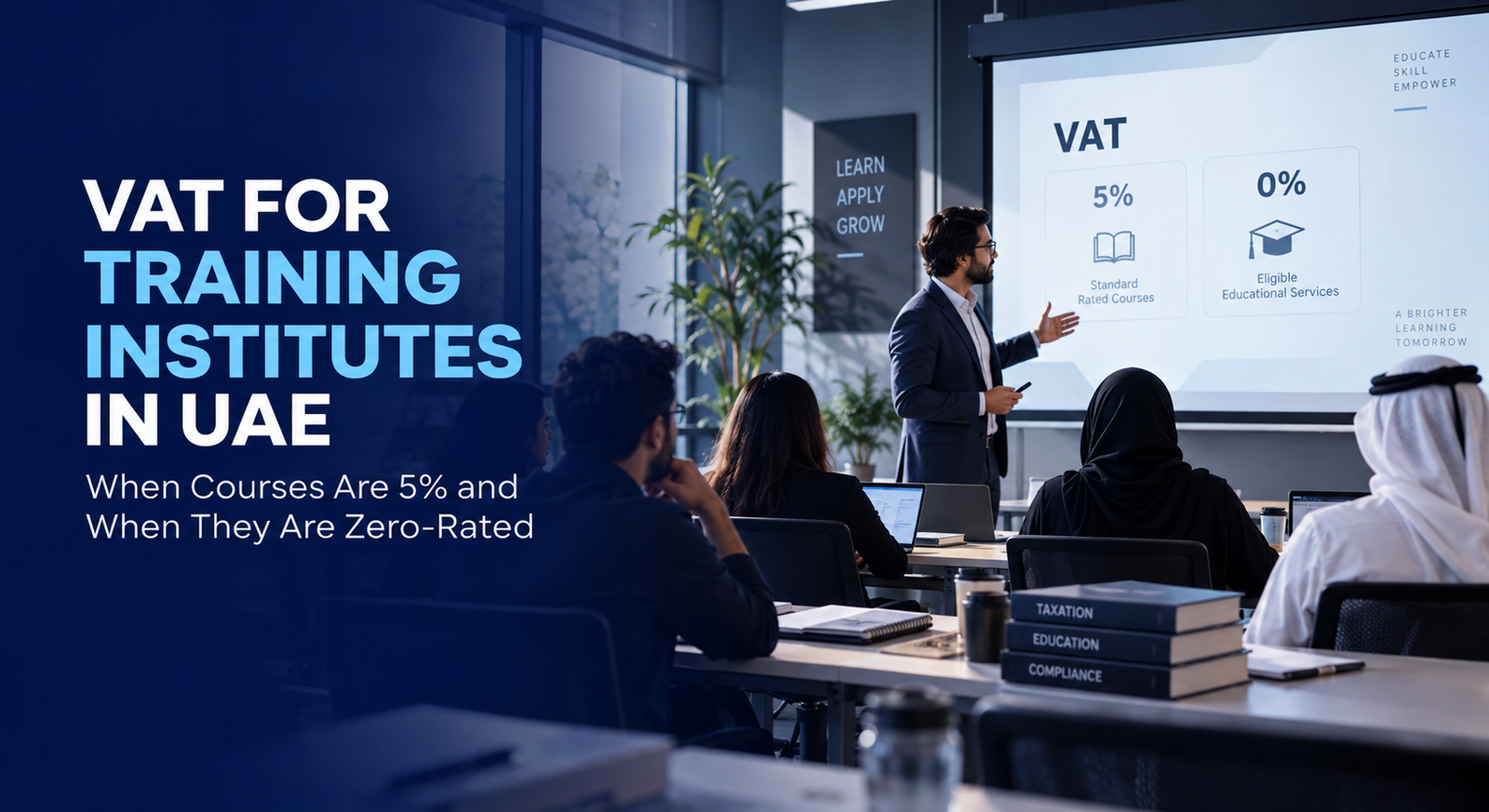
Most training institutes in the UAE charge 5% VAT on course fees, corporate training and coaching. Zero-rating applies to education services from recognised educational institutions, such as licensed schools and higher education providers, not to private training centres by default. Online courses sold to learners outside the GCC can be zero-rated if export conditions are met. VAT 201 returns are due by the 28th after each period.
- You run a training institute, coaching centre, language school or tutoring business in the UAE
- You deliver corporate training to companies or government entities
- You sell online courses to learners in the UAE and abroad
- You collect exam, certification or material fees alongside tuition
Not sure where you stand? Get a free 15-minute review or ask us on WhatsApp.
Does a training institute need to register for VAT in the UAE?
A training institute must register when its taxable course fees and other supplies exceed AED 375,000 in 12 months, or are expected to within the next 30 days. Zero-rated overseas course sales count toward that total, so an online academy can cross the threshold without a single UAE learner.
| Institute situation | VAT answer | Practical note |
|---|---|---|
| Course fees over AED 375,000 in 12 months | Mandatory registration | Late registration costs AED 10,000 plus backdated VAT |
| Fees between AED 187,500 and AED 375,000 | Voluntary registration available | Useful if corporate clients want tax invoices |
| Online courses sold only to learners abroad | Zero-rated sales still counted | You may need to register and file with little VAT to pay |
| Recognised school or higher education provider | Education may be zero-rated | Other activities like corporate courses can still be 5% |
| Institute run as a company | Corporate Tax registration required | Whatever the revenue |
Holding a training permit or activity licence does not by itself make your courses zero-rated education. Our VAT for education guide covers schools and universities, which follow different rules from training centres.
When are training courses zero-rated for VAT in the UAE?
Courses are zero-rated only when the education service is supplied by a recognised educational institution, such as a licensed nursery, school or higher education institution recognised by the relevant UAE education authority. A private coaching centre, IT bootcamp, language academy or soft skills trainer outside that recognition charges 5%.
Common course types and their usual treatment
| Course or service | Usual VAT | Why |
|---|---|---|
| Curriculum education at a recognised school or university | 0% | Recognised educational institution |
| Professional certification prep (accounting, project management) | 5% | Private training provider |
| IELTS, language and tutoring classes at a private centre | 5% | Not a recognised institution by default |
| Corporate leadership or sales training | 5% | Service to a business |
| Life, business or career coaching | 5% | Personal service |
| Online course sold to a learner outside the GCC | 0% if export conditions met | Export of services |
Corporate training at 5%
Training delivered to UAE companies, whether at their office or in your classroom, is a standard-rated service. Invoice the company, not the individual employees, with a full tax invoice showing both TRNs within 14 days. Government entities are charged 5% in the same way unless a specific relief applies to them.
Online courses for learners overseas
A recorded or live online course sold to a learner based outside the GCC can be zero-rated as an export of services, but the conditions are strict, including where the learner is and where they are when the service is received. Keep learner location evidence such as billing country and IP records. Our guide to zero-rated exported services explains the tests.
Is VAT charged on course materials, exam fees and advance tuition?
For a 5% training institute, course books, kits and platform access sold with the course are 5% too. Exam fees can be treated as a disbursement outside your VAT only when strict conditions are met; otherwise they form part of your taxable price.
Exam and certification fees
When you collect a fee on behalf of an awarding body and pay over exactly that amount, it may be a disbursement if you act as the learner’s agent, the fee is clearly the learner’s obligation, and it is shown separately at cost. Adding a handling margin, or bundling the exam into a package price, usually brings the whole amount into your 5% supply.
Advance fees, instalments and refunds
VAT is due when tuition is paid, even if the course starts next quarter, so a September enrolment drive for a January intake creates VAT in September. Instalment plans create VAT as each instalment is received or invoiced. When a learner withdraws and you refund, issue a credit note so the VAT comes back through your return.
Trainer invoices and venue costs
Freelance trainers who are VAT registered charge you 5%, which you recover with their tax invoice. Hotel meeting rooms, coffee breaks for delegates and printed workbooks also carry recoverable VAT when used for 5% courses, but hospitality for your own staff can be blocked.
How does a training institute file its VAT return?
A training institute files by splitting enrolments into 5% local courses, 0% export courses and any exam disbursements, then reconciling fees received to the VAT 201 on EmaraTax.
Export enrolments and payments
Pull course fees received and invoiced in the period from your student system and payment gateway.
Split by learner location and type
Separate UAE learners and companies (5%) from overseas online learners with evidence (0%).
Check exam fees
Keep only true disbursements outside VAT; move marked-up or bundled exam fees into taxable sales.
Record withdrawals and refunds
Make sure each refund has a credit note in the same period.
Gather input VAT
Trainer invoices, venue hire, platform subscriptions, marketing and rent, each with your TRN.
Account for overseas software
Apply reverse charge on learning platforms and ad services billed from abroad.
Complete and submit the VAT 201
Enter standard-rated, zero-rated and reverse charge figures, then pay by the 28th.
What documents should a training institute keep for VAT?
Keep enrolment, invoicing and location evidence for at least 5 years, so each 0% or out-of-scope amount can be explained.
- Enrolment records with learner or company name and course dates
- Tax invoices to companies and receipts or simplified invoices to individuals
- Evidence of overseas learner location for zero-rated online sales
- Awarding body invoices and receipts supporting exam disbursements
- Credit notes for withdrawals, transfers and refunds
- Trainer, venue and platform purchase invoices
- Reverse charge records for overseas software and advertising
- Evidence of recognised institution status, if you zero-rate any education
What VAT deadlines apply to a training centre?
The return and payment for each tax period are due by the 28th of the following month, and enrolment peaks make timing matter.
| Deadline | Date | Training centre example |
|---|---|---|
| Tax invoice to a corporate client | Within 14 days of supply | Workshop run 8 September, invoice by 22 September |
| VAT 201, quarter ending 30 September 2026 | 28 October 2026 | Includes September enrolments for January intakes |
| VAT 201, quarter ending 31 December 2026 | 28 January 2027 | Includes year-end corporate training budgets |
| Corporate Tax return, December 2025 year end | 30 September 2026 | Training companies file even at a loss |
| E-invoicing ASP appointment, revenue under AED 50M | 31 March 2027 | Go live 1 July 2027 |
| Reconsideration request | 40 business days after the decision | Then the Tax Disputes Resolution Committee |
What are the VAT penalties for training institutes in 2026?
Training institutes are penalised under Cabinet Decision 129/2025 from 14 April 2026, and wrongly zero-rated courses are the usual starting point for an incorrect return.
| Violation | Penalty | Training institute trigger |
|---|---|---|
| Late registration | AED 10,000 plus backdated output VAT | Assuming training is education and outside VAT |
| Late return | AED 1,000 first, AED 2,000 repeat within 24 months, per return | Filing after the enrolment rush |
| Late payment | 14% a year, calculated monthly | Advance fees spent on marketing |
| Incorrect return | AED 500 first, AED 2,000 repeat | Local courses reported as zero-rated |
| Tax invoice or credit note not issued | AED 2,500 per case | Refunded learner with no credit note |
| Records not kept | AED 10,000 for a first violation | No proof of overseas learner location |
| Voluntary disclosure | 1% a month before an audit notice; 15% plus 1% a month after | Correcting past zero-rated courses |
How it stacks: an institute that zero-rated AED 240,000 of local courses over a year owes AED 12,000 of VAT it never collected from learners. Disclosed voluntarily with an average of 5 months since the due dates, the charge is about AED 600 (AED 12,000 x 1% x 5), and the institute bears the VAT itself because the fees were already paid.
Zero-rating courses you are not sure about?
Send us your course list and last quarter's return and we will flag anything that should have been 5%.
6 VAT mistakes training institutes make
These are the errors that show up most when we review training and coaching businesses, and each one opens a penalty.
- Zero-rating courses because they are educational. Only recognised educational institutions zero-rate education, so a private centre doing this under-declares VAT on every enrolment.
- Zero-rating online sales without location evidence. Without proof the learner is outside the GCC, the sale is treated as 5%.
- Treating marked-up exam fees as disbursements. Once a margin or bundle is involved, the fee is part of your taxable supply.
- Accounting for VAT when the course starts, not when fees are paid. Early enrolment payments move VAT into an earlier return.
- Refunding withdrawals without credit notes. Each missing credit note can cost AED 2,500.
- Invoicing employees instead of the corporate client. The company cannot recover the VAT, and your invoices do not match the contract.
How can a training institute avoid VAT penalties?
Build VAT checks into the enrolment cycle, so each intake is classified correctly before the quarter closes.
- At course set-up: decide and record the VAT treatment of each course and bundle
- Monthly: invoice corporate clients within 14 days of each session
- Monthly: capture learner location evidence for every online sale you zero-rate
- Monthly: issue credit notes for withdrawals and refunds
- Monthly: if not registered, add up 12 months of course fees, overseas sales included, against AED 375,000
- Quarterly: reconcile fees received, the ledger and the VAT 201
- Quarterly: file and pay by the 28th
- Annually: review exam fee arrangements with awarding bodies
The VAT return checklist has the general pre-filing checks, and our accounting guide for nurseries and private schools covers deferred fee accounting that also applies to long courses.
Training institute late on VAT or received an FTA notice?
File the overdue return and pay the VAT now, since late payment is added every month the balance stays unpaid. Then correct any courses you zero-rated wrongly.
- File and pay immediately, treating uncertain courses at 5% until confirmed.
- Correct wrongly zero-rated courses by voluntary disclosure. The charge before an audit notice is 1% a month; our voluntary disclosure guide covers the steps.
- Submit a reconsideration request within 40 business days if a penalty is wrong, with your institution status evidence; see our reconsideration guide.
- Escalate to the Tax Disputes Resolution Committee if refused.
- Never registered because you thought training was exempt? Start with late VAT registration and backdated VAT.
FTA notice about your institute's VAT?
Share the notice and your course list, and we will tell you what to correct first.
Worked example: a Dubai training institute's quarter
This illustrative Dubai professional training institute sells corporate programmes, public classroom courses and online courses to overseas learners. It had wrongly zero-rated its public courses as education.
| Line | AED | Working |
|---|---|---|
| Corporate training (net) | 220,000 | 5% |
| Public classroom courses in Dubai (net) | 60,000 | 5% |
| Online courses to learners outside the GCC | 70,000 | 0%, evidence held |
| Output VAT | 14,000 | 280,000 x 5% |
| Input VAT on trainers, venues, platform, rent | 5,000 | 100,000 x 5% |
| Correct net VAT payable | 9,000 | 14,000 minus 5,000 |
| VAT reported when public courses were zero-rated | 11,000 | 220,000 x 5% |
| Net VAT reported instead | 6,000 | 11,000 minus 5,000 |
| Under-declared VAT | 3,000 | 60,000 x 5% |
| Disclosure 4 months after the due date | 120 | 3,000 x 1% x 4 |
| If the correct return were one month late | 1,105 | 1,000 + (9,000 x 14% / 12) |
The disclosure charge is small; the real cost is the AED 3,000 of VAT the institute cannot now collect from learners who already paid.
Should a training institute file VAT itself or hire an accountant?
A coach with local clients only can file a simple return; an institute mixing corporate, public, online and exam income usually benefits from a reviewed return each period.
| Option | Cost | Time needed | Risk | Suits |
|---|---|---|---|---|
| Owner or admin team | No fee | High at intake and quarter end | Zero-rating and exam fee errors | Solo coaches with local clients |
| Freelance accountant | Typical market range: varies with course volume | Medium | Location evidence often not checked | Small centres with one course type |
| Accounting firm (Paci) | Bookkeeping from AED 599/month; VAT filing on a fixed quote within 24 hours | Low | Qualified accountant reviews course treatment and evidence | Institutes with corporate, online and exam income |
Our VAT return filing service reviews each course type’s treatment before the return is submitted.
What training institute owners ask us about VAT
We want to open a training institute in Dubai. What tax registrations do we need?
Beyond the licence and any education approvals, the company must register for Corporate Tax, and VAT registration is mandatory once taxable course fees pass AED 375,000 in 12 months. Plan on charging 5%, since zero-rating is limited to recognised educational institutions.
Our free zone company sells courses only to learners outside the UAE. Do we still need VAT registration?
Possibly yes. Services exported outside the GCC can be zero-rated when the conditions are met, but zero-rated sales still count toward the AED 375,000 threshold, so you may have to register and file even with no local VAT to collect.
We deliver online training to a client in another country. Do we add VAT to the invoice?
If the client is outside the GCC and the export conditions are met, the invoice can show 0%. If the training is delivered to a UAE client, or the conditions are not met, 5% applies. Keep contract and location evidence with each invoice.
Why do learners get quoted course fees plus VAT? Isn't training education?
Zero-rating covers education from recognised educational institutions only. Most private training, coaching and skills courses are standard-rated at 5%, even when the content is educational.
How is a coaching centre different from my children's school for VAT?
Education services from a recognised school are zero-rated, so qualifying school fees carry no VAT. A tutoring or coaching centre outside that recognition charges 5% on its fees, even for the same subjects. Our Corporate Tax guide for schools and nurseries covers the school side.
Frequently asked questions
Is VAT charged on training courses in Dubai?+
Yes, most training courses in Dubai carry 5% VAT. Only education from recognised educational institutions is zero-rated, plus online courses exported to learners outside the GCC where the conditions are met.
Is coaching subject to VAT in the UAE?+
Business, life, career and exam coaching is a standard-rated service at 5% once the provider is VAT registered. Coaches below AED 375,000 of taxable income a year are not required to register; our VAT guide for freelancers covers solo coaches.
Does a training institute need a tax invoice for every learner?+
Companies paying for training need a full tax invoice within 14 days. Individual learners can receive a simplified tax invoice for amounts under AED 10,000. Refunds need a credit note either way.
How often does a training centre file VAT returns?+
Usually quarterly, by the 28th of the month after each period, as assigned by the FTA. See our guide to quarterly vs monthly VAT returns.
Can a training institute recover VAT on venue and trainer costs?+
Yes, VAT on venues, trainers, platforms and marketing used for 5% or zero-rated courses is recoverable with valid tax invoices. VAT on entertainment for your own staff is generally blocked.
What is the penalty if a training institute charges the wrong VAT rate?+
The incorrect return costs AED 500 the first time and AED 2,000 for a repeat, plus 1% a month on any tax difference disclosed before an audit notice. Our VAT penalties guide lists the full schedule.
Do training institutes pay Corporate Tax on advance course fees?+
Corporate Tax follows your accounts, where advance fees for courses not yet delivered are usually deferred. Our Corporate Tax guide for training institutes explains deferred revenue and filing.
Get your training institute's VAT reviewed for free
In a free 15-minute review a qualified accountant checks the VAT treatment of your courses, online sales evidence, exam fees and last return. You get a fixed quote within 24 hours for ongoing VAT filing.
- A free 15-minute review with a qualified accountant
- A fixed quote within 24 hours, no hourly billing
- We reply on WhatsApp or email, whichever you prefer
Continue on WhatsApp now →
- FTA: Registration for VAT
- FTA: VAT Executive Regulations (consolidated)
- Ministry of Finance: Cabinet Decision No. 40 of 2017 and amendments
- FTA: Waiver of penalties
Checked against these sources on 15 September 2026. This guide is general information for UAE businesses, not advice on your specific facts.